Most enterprise AI initiatives are nothing more than expensive experiments that fail to survive the pilot phase. They lack the structural integrity required to scale across a complex organization. Your current ai automation strategy for enterprise likely faces the same friction; fragmented tools, data silos, and technical debt from legacy Excel processes. It's a common struggle. Business leaders often find themselves managing a patchwork of "solutions" that don't talk to each other and fail to show a clear return on investment. You need a framework built for high-performance standards, not just more software.
This article delivers the 2026 Performance Framework to help you master the strategic architecture required to scale intelligent automation. We'll move past the hype to focus on tangible outcomes and measurable ROI. You'll gain a structured roadmap for deployment, governance frameworks that satisfy IT security, and a blueprint for operational efficiency using custom AI apps and agents. We'll replace fragile legacy workflows with secure, scalable systems. It's time to stop experimenting and start engineering for results.
Key Takeaways
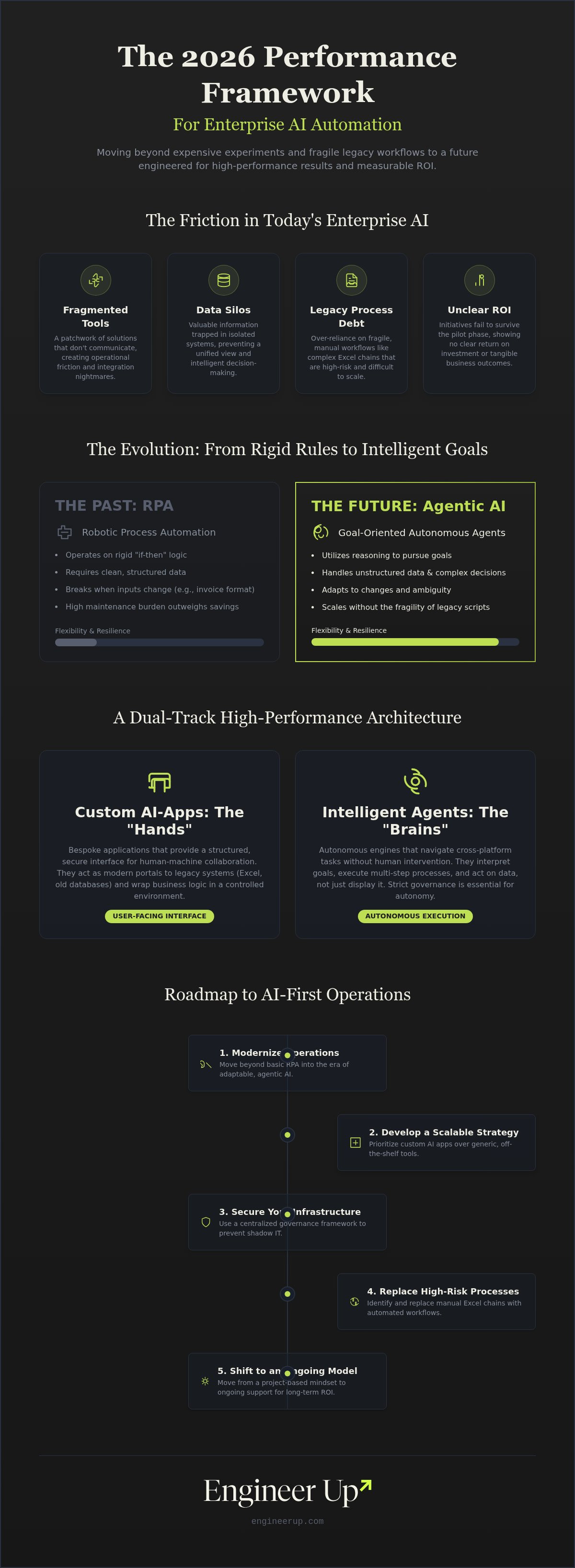
• Modernize your operations by moving beyond basic RPA into the era of agentic AI.
• Develop a scalable ai automation strategy for enterprise that prioritizes custom AI apps over generic, off-the-shelf tools.
• Secure your infrastructure against shadow IT with a centralized governance framework for autonomous agents.
• Identify and replace high-risk legacy processes like manual Excel chains with high-performance automated workflows.
• Shift from a project-based mindset to an ongoing support model to ensure long-term ROI and technical stability.
Defining Enterprise AI Automation Strategy in 2026
Enterprise AI is not a collection of chatbots. It is an architectural overhaul. A successful ai automation strategy for enterprise functions as a comprehensive framework for deploying intelligence across every business unit. Without this framework, organizations end up with fragmented "AI silos" where tools are purchased but never integrated. Strategy must precede tool selection. Buying software before defining the logic is a recipe for technical debt and operational friction. AI Automation Strategy is the alignment of business logic with autonomous execution.
The Shift from RPA to Agentic AI
Traditional Robotic Process Automation (RPA) served its purpose by handling repetitive, rule-based tasks. It operates on rigid "if-then" logic. If the data is clean and the rules are fixed, RPA works. However, it has zero flexibility. If a vendor changes an invoice format or a field moves, the bot breaks. This creates a maintenance burden that often outweighs the initial savings.
2026-era Agentic AI represents a fundamental shift. It utilizes reasoning to handle unstructured data and complex decision-making. These agents don't just follow steps; they pursue goals. They can interpret an ambiguous email, cross-reference it with a database, and decide on the next best action. The strategic move from rigid logic to goal-oriented autonomous agents allows an enterprise to scale without the fragility of legacy scripts. It moves the burden of technical complexity from the human operator to the system.
Core Objectives: Efficiency vs. Innovation
A robust roadmap must balance two distinct goals: efficiency and innovation. Task elimination is the first priority. This involves removing monotonous data entry and manual orchestration that drains your workforce. We replace these with high-performance automations that work around the clock. This isn't just about saving time; it's about structural integrity.
Task augmentation is the second priority. This empowers high-value employees with intelligent co-pilots. Instead of replacing the professional, the AI assumes the burden of complex technical challenges. It handles data retrieval and synthesis so the human can focus on high-level strategy and decision-making. Identifying high-impact opportunities within the existing enterprise value chain is critical. We look for "hidden" manual processes, often buried in Excel sheets or email chains, and transform them into custom AI-Apps. This creates a stable, high-performance foundation for the entire organization.
Architecture: Distinguishing AI Apps from Intelligent Agents
A high-performance ai automation strategy for enterprise demands a dual-track architecture. You cannot rely on a single delivery method for intelligence. Deployments generally fall into two categories: custom applications and autonomous agents. Understanding the distinction is vital for resource allocation and security. While apps provide the structured interface for human-machine collaboration, agents serve as the reasoning engine that executes tasks independently. Both require a unified data foundation to prevent the AI silos mentioned in the previous section. To understand the implementation of What is Enterprise AI? in an agentic context, businesses must focus on goal-oriented logic rather than simple scripts.
Custom AI-Apps: The Interface of Intelligence
Off-the-shelf software often fails to meet specific enterprise requirements. These generic tools force users to change their workflows to fit the software's limitations. This is inefficient. Bespoke AI applications solve this by wrapping business logic around a specialized interface. They are particularly effective for legacy system integration. If your team still relies on complex Excel sheets or aging databases, a custom app provides a modern, secure portal to that data. These apps act as the "hands" of your strategy, giving users a controlled environment to interact with intelligent models. For deep technical specifications on building these systems, consult our Custom AI App Development: 2026 Performance Guide.
Intelligent Agents: The Future of Autonomous Workflows
Intelligent agents are the brains of the operation. Unlike static apps, agents navigate cross-platform tasks without constant human intervention. They utilize advanced reasoning engines to interpret goals and execute multi-step processes. An agent doesn't just display data; it acts on it. It might pull a report from a Microsoft CRM, analyze the sentiment, and draft a response in Outlook. This level of autonomy requires strict governance and a clear architectural plan. We specialize in building these reasoning engines within the Microsoft ecosystem. Our Enterprise AI Agent Consulting services help organizations design agents that provide actual business value. A successful strategy balances these autonomous workers with user-facing apps to create a seamless operational environment. If you're ready to move beyond generic bots, consider how custom AI-Apps development can modernize your legacy workflows.
Governance: Scaling AI Without Creating Shadow IT
Scaling an ai automation strategy for enterprise without a central command structure leads to "Shadow AI." This occurs when individual departments bypass IT to procure niche AI tools for specific tasks. It results in fragmented data silos and significant security vulnerabilities. A centralized framework isn't a bottleneck. It is the foundation for operational stability. Organizations must establish a unified governance model before the first agent is deployed. This prevents the "wild west" of unsanctioned software that often leads to catastrophic data leaks and unmanaged technical debt.
The Power Platform Governance Model
Microsoft Power Platform serves as the primary vehicle for centralizing automation efforts. It allows IT leadership to manage permissions and enforce strict Data Loss Prevention (DLP) policies across all AI-Apps. This ensures that proprietary data only moves through authorized channels. Centralization allows for the rapid deployment of custom applications while maintaining the structural integrity of the enterprise network. For organizations looking to scale their digital infrastructure without compromising security, our Power Apps Consulting Services provide the blueprints for secure, high-performance automation.
Risk Management and Security
Compliance is a technical requirement, not a suggestion. AI implementations must satisfy industry-specific regulations such as HIPAA, SOC2, or GDPR. This demands robust auditing logs for every decision an autonomous agent makes. Transparency ensures that any logic error is traceable and remediable. You must also prioritize the protection of proprietary enterprise data. High-performance systems use private environments to prevent sensitive information from leaking into public LLM training sets. Security is not an afterthought; it's a core architectural component.
A resilient strategy remains model-agnostic. Relying on a single AI vendor creates a single point of failure and limits your ability to pivot as technology evolves. By building an architecture that can switch between different models, you maintain strategic flexibility. For high-stakes operations, "Human-in-the-loop" (HITL) protocols are essential. The AI assumes the burden of data synthesis and complex analysis. The human operator provides the final validation for high-risk outputs. This balance ensures maximum efficiency without sacrificing accuracy or safety. It turns potential liabilities into reliable, enterprise-grade assets.
Building the Roadmap: From Legacy Workflows to AI-First Operations
A successful ai automation strategy for enterprise requires a ruthless audit of existing workflows. You cannot automate chaos. Most organizations harbor "hidden" manual processes buried in fragmented Excel sheets and endless email chains. These are the primary sources of operational friction. Mapping these workflows is the first step toward building a high-performance roadmap. Prioritize candidates based on a three-tier assessment: ROI potential, technical complexity, and security risk. This methodical approach ensures that resources are allocated to the highest-impact areas first.
Select a technology stack that integrates with your current infrastructure. For most enterprises, this means prioritizing the Microsoft ecosystem. A phased rollout prevents systemic shock and allows for course correction. Start with a pilot phase to validate the business logic in a controlled environment. Once validated, move to full-scale deployment and establish a framework for ongoing support. Execution is a steady, purposeful progression. It is not a sudden switch. If your current roadmap is stalled by technical debt, partner with Engineer Up to build a high-performance automation foundation.
Modernizing Legacy Processes
Replacing fragile Excel workbooks with secure Power Apps is a non-negotiable prerequisite for enterprise AI. Excel lacks the structural integrity required for modern scaling. It creates data silos, version control nightmares, and significant security risks. By migrating these processes into a structured Power Platform environment, you create the clean, reliable data streams that intelligent agents require to function. This transition eliminates bottlenecks that drain operational capacity and prepares your data for autonomous reasoning. Explore our Business Process Automation Services to learn how we optimize core workflows for the AI era.
Measuring ROI and Performance
Move beyond "hours saved" as your primary metric. That is a surface-level calculation that fails to capture the full value of automation. True ROI in a 2026 framework is measured through error reduction, speed-to-market, and improved data accuracy. High-performance automation maintains its value through specialized ongoing support. AI models and agents require constant monitoring to ensure they don't drift as business logic evolves. Set realistic benchmarks for the first 12 months of deployment. Focus on achieving stability and transparency before chasing aggressive optimization. Stability is the precursor to sustained growth.
Execution and Support: Turning Strategy into Sustained ROI
Execution is where most plans fail. A successful ai automation strategy for enterprise is not a static document. It is a living operational framework. Many organizations treat AI deployment as a "one-and-done" software installation. This is a mistake. AI models drift. Business logic changes. APIs update. Without ongoing performance support, even the most advanced systems become obsolete within months. You need a partner that handles the technical burden of the entire lifecycle. Refining your ai automation strategy for enterprise requires a shift from project-based thinking to a service-oriented model.
Generalist agencies often lack the technical depth required for enterprise-grade automation. They focus on surface-level features and simple API calls. High-performance systems require deep architectural knowledge of the Microsoft ecosystem and Power Platform. Engineer Up assumes the burden of AI agent lifecycle management. We don't just build tools. We engineer sustained ROI through technical mastery and proactive maintenance. We are doers, not talkers. Our focus remains on the quality of the output and the stability of the system.
The Value of Specialized AI Consulting
Enterprise-grade AI requires more than a basic chatbot. It demands a robust integration of custom AI-Apps and autonomous agents that interact with your legacy data. Generalists might promise quick fixes. Specialized firms deliver structural integrity. We focus on end-to-end development. This includes initial strategy, custom application builds, and the ongoing performance support mentioned earlier. This specialized focus ensures that your automation remains secure, compliant, and efficient. Engineer Up is the partner for organizations that value substance over superficiality.
Next Steps for Enterprise Leadership
Transformation starts with a ruthless readiness assessment. You must identify which business units are prepared for high-performance automation. Identify the workflows that still rely on manual data entry or fragmented spreadsheets. Assemble a cross-functional group of stakeholders. This group should include leadership from IT, security, and core operations to ensure governance is baked into the roadmap from day one. This prevents the shadow IT risks discussed in previous sections and ensures technical alignment across the organization.
The final step is moving from theory to execution. Contact specialized experts to build your custom roadmap. We replace legacy technical debt with high-performance systems that drive measurable results. If you're ready to master the strategic architecture required for scale, our strategy consulting team is prepared to begin the transition. Stop managing fragmented tools. Start engineering a unified future.
Engineering Your AI-Driven Future
Transitioning to an AI-first operation requires more than purchasing software. It demands a structural shift from fragmented tools to a unified architecture. A successful ai automation strategy for enterprise replaces legacy Excel debt with secure Power Apps and goal-oriented agents. Governance and ongoing support are the critical pillars that ensure these systems scale without creating security risks or technical drift. You must prioritize structural integrity over superficial features to achieve lasting results.
Maintaining high-performance standards in 2026 means partnering with specialized experts who assume the technical burden of lifecycle management. Engineer Up provides the technical mastery required to build and support these complex systems. As Microsoft Power Platform Specialists and Custom AI Agent Architecture Experts, we deliver End-to-End Performance Support that turns strategic vision into tangible ROI. Contact Engineer Up for a Strategic AI Readiness Consultation to begin your transition. It's time to stop managing manual bottlenecks and start building a resilient, automated enterprise.
Frequently Asked Questions
What is the first step in creating an AI automation strategy for enterprise?
The first step is a ruthless audit of your existing manual workflows. You must identify "hidden" processes currently buried in Excel sheets and email chains. These legacy methods create the most friction and are the primary candidates for modernization. Mapping these workflows allows you to prioritize automation based on ROI potential and technical risk. Establishing this foundation ensures your ai automation strategy for enterprise is built on clean business logic rather than chaotic technical debt.
How does agentic AI differ from traditional business process automation?
Agentic AI utilizes reasoning engines to pursue specific goals rather than following rigid scripts. Traditional business process automation depends on "if-then" logic that breaks when data formats change. Agents can interpret unstructured data and navigate cross-platform tasks without human intervention. This shift moves the enterprise from simple rule-based execution to autonomous decision-making. It allows for a more resilient and flexible operational framework that scales across complex organization structures.
What are the biggest risks of scaling AI without a central strategy?
Scaling without a central strategy creates "Shadow AI" where departments buy niche tools independently. This results in fragmented data silos and significant security vulnerabilities. Proprietary data might leak into public training sets if governance isn't centralized. You also face unmanaged technical debt and overlapping software costs. A unified ai automation strategy for enterprise prevents these risks by establishing strict permissions and data loss prevention policies from the start of deployment.
Can custom AI agents integrate with our legacy enterprise systems?
Custom AI agents integrate seamlessly with legacy systems through specialized interfaces and custom AI-Apps. We focus on wrapping modern reasoning engines around your existing databases and ERPs. This allows you to extract value from aging infrastructure without a total system replacement. Using the Microsoft ecosystem, we build secure portals that connect autonomous agents to your proprietary data. This approach turns isolated legacy systems into active participants in your automated business logic.
How do we measure the ROI of enterprise AI automation?
Measuring ROI requires looking beyond "hours saved" to more complex performance indicators. You must track error reduction rates, speed-to-market improvements, and data accuracy gains. High-performance automation also delivers value through structural integrity and risk mitigation. Evaluate how custom agents assume the burden of complex technical challenges, allowing high-value employees to focus on strategic goals. These metrics provide a more transparent and realistic view of the long-term financial impact on your organization.
What is the role of the Microsoft Power Platform in AI strategy?
The Microsoft Power Platform serves as the primary engine for centralizing enterprise automation efforts. It provides the necessary infrastructure for managing permissions and enforcing Data Loss Prevention policies. This ecosystem allows for the rapid development of custom AI-Apps that integrate directly with your existing business tools. It is the most effective vehicle for scaling intelligence while maintaining strict IT governance. We use it to replace fragile manual processes with secure, high-performance systems.
How do we prevent Shadow IT when deploying AI tools across departments?
Preventing Shadow IT requires a centralized governance framework that manages all AI agent deployments. You must establish strict permission protocols and DLP policies to control how data moves between departments. Providing authorized, high-performance custom apps reduces the incentive for teams to seek unsanctioned third-party tools. This approach ensures that all automation efforts align with the organization's security standards. Transparency and auditing logs are essential for maintaining control over the entire AI lifecycle.
Why do we need ongoing support for AI-driven applications?
Ongoing support is mandatory because AI models drift and business logic evolves. Technical maintenance ensures that agents continue to perform accurately as APIs update and data structures change. Without proactive monitoring, an automated system can quickly become a liability rather than an asset. We provide end-to-end performance support to manage the entire lifecycle of your AI-Apps. This commitment to stability ensures that your automation foundation remains resilient and continues to deliver sustained ROI.
WRITTEN BY
Get Your Team AI Ready
Let's hear your use case - we'll help you get on the path to AI readiness.

FILED UNDER
TOOLS IN THIS POST

