Development got faster. The calendar didn't move.

Your developers have AI, and your projects still take just as long. That's because development was never where the time went. Build at the Speed of AI shows how three Engineer Up architects use AI to speed up discovery, estimation, planning, and testing, with the real numbers, tools, and failures from their client work.

Get the white paper 32 pages · Plain language, no code
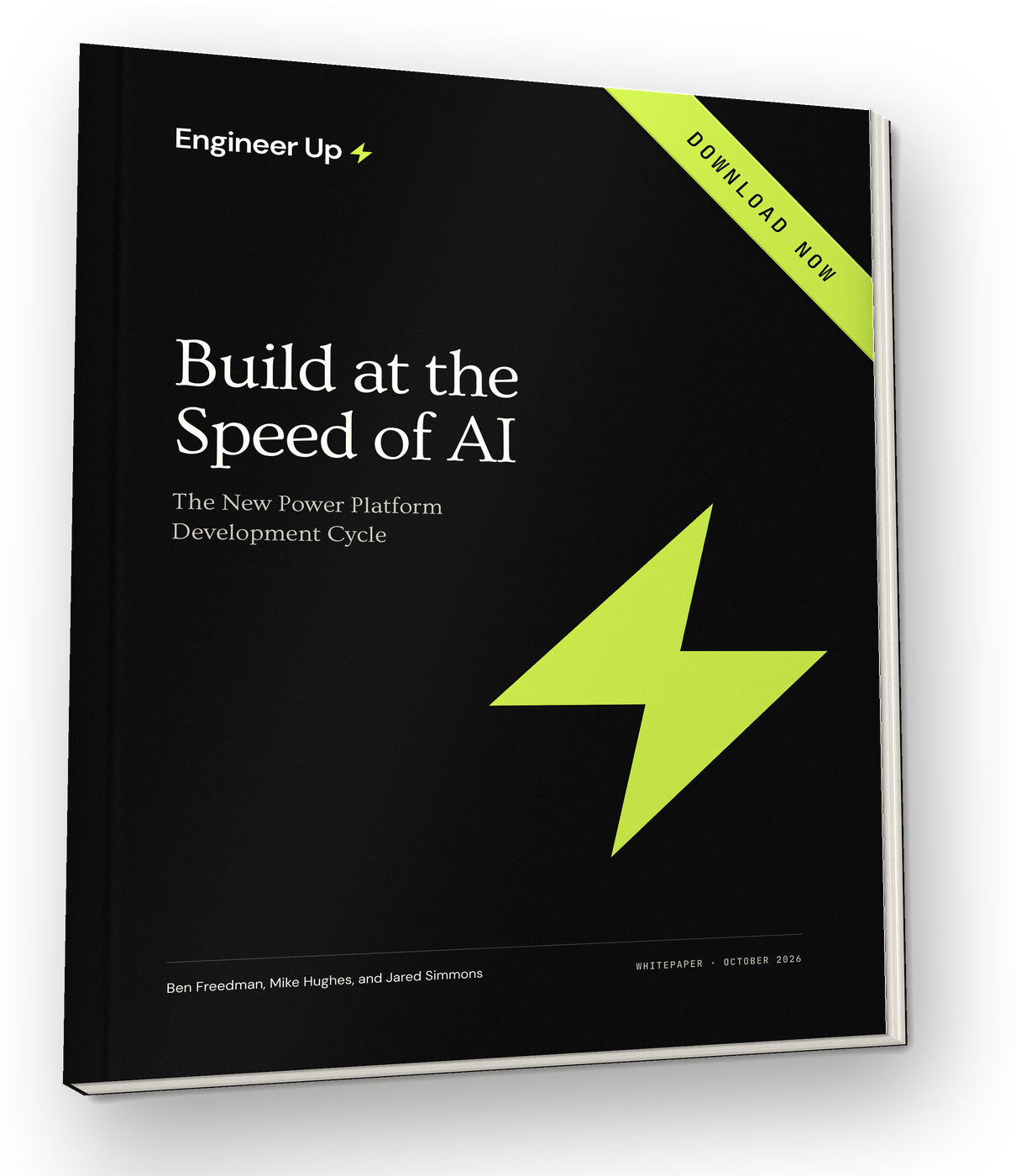
Cover of the Build at the Speed of AI white paper by Ben Freedman, Mike Hughes, and Jared Simmons

Get your copy

Your download is ready as soon as you submit.

You're all set. Here's your copy.

Download the white paper
Oops! Something went wrong while submitting the form.
What you'll take away
  1. 1

    Discovery in days, not weeks

    How one team showed a client initial value in a week, where four to six weeks is typical, and the rules that keep AI from inventing process steps.

  2. 2

    A backlog built from what you already know

    Turn a discovery week into stories with testable acceptance criteria, and know which calls still belong to your people.

  3. 3

    Work you can trust

    Make AI measure before it claims, catch silent data errors, and audit AI-written tests before they grade their own homework.

  4. 4

    Proof it's paying off

    The one number to track: AI cost, people's time, and rework, divided by accepted work.

Questions

Do I need to be technical to get something out of it?

No. It's written for the people who run delivery, in plain language with no code. Each chapter ends with a deeper section you can forward to your architect.

Is it only about Power Platform?

The examples come from Power Platform projects, but the method isn't tied to it: give the tools your business, technical, and people context, hold them to your rules, and keep a senior person making the calls.

Which AI tools does it cover?

The authors name what they used, including Microsoft 365 Copilot, Claude Code, Playwright, and Power Platform pipelines. Every chapter also lists what Microsoft ships and where to branch out, and the process doesn't depend on any one product.

Is this just a list of wins?

No. It covers what went wrong too: an invented process step that spread into eleven backlog items, a design document wiped to zero bytes, and AI-written tests that graded their own homework. Each failure comes with the rule it produced.

Does this mean I can staff projects with juniors instead?

No, and the paper says so directly. The gains come from making your senior people faster decision makers. Somebody senior still has to be in the room.

Where should my team start?

The paper ends with what to do on Monday: sort one piece of in-flight work into what a tool could draft, what your people build, and what the business decides, then start measuring whether it's paying off.
30-min strategy call

Tell us what's broken.

Bring one process you'd fix tomorrow if you had the right team. We reply within one business day.

✕
Thank you! Your submission has been received!
Oops! Something went wrong while submitting the form.