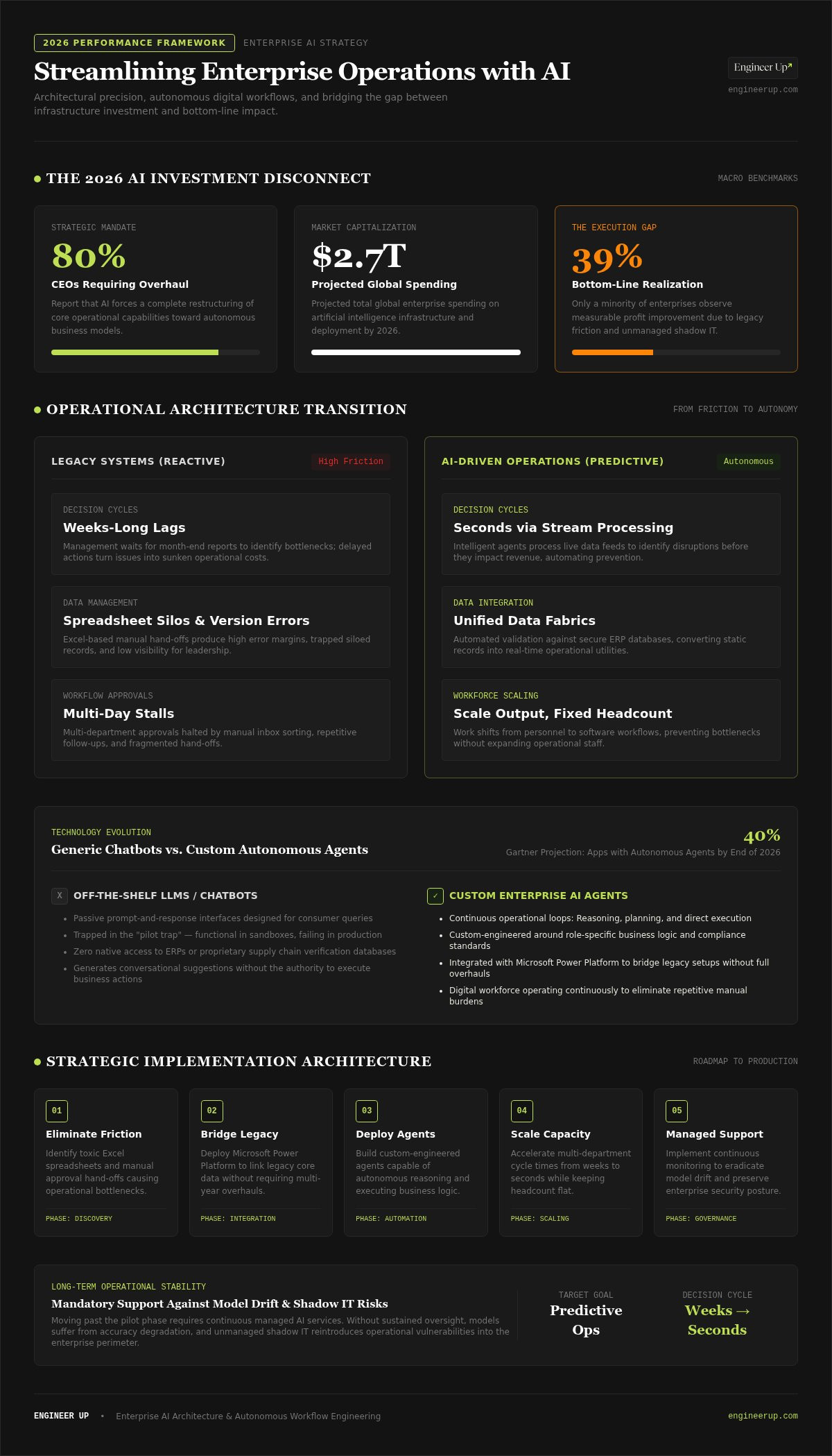
Eighty percent of CEOs now report that AI is forcing a total overhaul of their operational capabilities. This isn't a trend. It's a fundamental shift toward the autonomous business. Global AI spending is projected to hit $2.7 trillion in 2026, yet only 39% of enterprises see a real improvement in their bottom line. The primary obstacle to streamlining enterprise operations with ai remains legacy process friction and the security risks of unmanaged shadow IT. You know that generic software cannot fix a broken foundation.
This article provides the 2026 Performance Framework to bridge the gap between investment and impact. You will learn to master the architecture of AI-driven efficiency to eliminate bottlenecks and scale performance. We will detail how custom AI agents and Microsoft Power Platform integrations reduce manual labor and accelerate decision cycles. This guide outlines the path to workflows that scale without increasing your headcount. It's time to move past the pilot phase and engineer actual results.
Key Takeaways
• Learn the 2026 framework for streamlining enterprise operations with ai by replacing manual friction with autonomous workflows.
• Distinguish between generic chat tools and custom AI Agents built to execute complex business logic.
• Bridge legacy systems with AI using the Microsoft Power Platform to avoid total infrastructure overhauls.
• Implement a 5-step roadmap to prioritize high-impact wins and ensure organizational scalability.
• Understand why ongoing support is mandatory to mitigate model drift and maintain high-performance standards.
The Evolution of Enterprise Efficiency: From Manual Workflows to AI Integration
In 2026, operational efficiency is no longer measured by human output. It is defined by architectural precision. True efficiency means building systems that anticipate needs rather than just responding to prompts. This shift requires moving beyond basic business process automation toward autonomous reasoning. Enterprises that lead their sectors are streamlining enterprise operations with ai by embedding intelligence into their core infrastructure. Generic tools are insufficient. You need a framework that respects your specific business logic and data security.
To better understand how these systems coordinate complex tasks, watch this breakdown of multi-agent orchestration:
Off-the-shelf LLMs provide conversational support but lack operational depth. They can't access your legacy ERP or validate a supply chain invoice against a contract stored in a secure database. This creates a "pilot trap" where projects look good in a sandbox but fail in production. Real efficiency requires a specialized approach that integrates with existing data fabrics. For logistics and haulage businesses, Logivo.ai provides a specialized AI-powered platform to automate complex transport workflows. It's about moving the burden of labor from your staff to your software. You don't need another chatbot; you need a workforce of digital agents.
Identifying Modern Operational Friction
Legacy processes are the silent killers of enterprise growth. Excel-based workflows are particularly toxic in 2026. They create version control nightmares and high error margins that compound over time. When data is trapped in spreadsheets, it stays siloed and invisible to leadership. Multi-department approval cycles often stall for days because of manual hand-offs and endless email sorting. This "bottleneck effect" consumes hours of expensive talent on low-value tasks. Information retrieval shouldn't be a manual labor project. It should be an instant utility that powers every department simultaneously.
The Shift from Reactive to Predictive Operations
Reactive management is a cost center. Waiting for a month-end report to reveal a delay means the loss has already occurred. AI shifts the focus to prevention. By processing real-time data streams, intelligent agents identify potential disruptions before they impact the bottom line. This transition depends on a robust ai automation strategy for enterprise to ensure every tool serves a measurable goal. Decision-making cycles move from weeks to seconds. Streamlining enterprise operations with ai allows you to engineer problems out of existence. This is how you scale performance without adding to your headcount.
Core Technologies for Streamlining Operations: Custom Apps and Intelligent Agents
Generic LLM interfaces are for consumers. Enterprise performance requires precision engineering. In 2026, the gap between a standard chatbot and a custom-engineered AI application has widened into a chasm. While a chatbot waits for a prompt, an autonomous agent monitors your operational data and acts. Streamlining enterprise operations with ai depends on moving beyond passive text generation toward active business logic execution. You need systems that don't just suggest answers but actually perform the work.
Custom AI apps provide the necessary interface for these complex interactions. They wrap powerful models in a layer of security and usability tailored to specific corporate roles. Gartner projects that 40% of enterprise applications will feature task-specific autonomous AI agents by the end of 2026. This isn't about adding a search bar to your intranet. It's about deploying a digital workforce that understands your specific data structures and compliance requirements. High-performance needs demand custom ai app development for business to ensure the technology serves the process.
The Architecture of Custom AI Agents
An agentic workflow differs fundamentally from a simple prompt-response loop. These systems utilize a cycle of reasoning, planning, and tool execution. An agent observes a business need, determines the necessary steps, and interacts with internal APIs to complete the task. They can navigate ERP systems, cross-reference invoices, and update CRM records without human intervention. To manage the inherent technical risks, these architectures should align with the NIST AI Risk Management Framework. Professional enterprise ai agent consulting is often required to bridge the gap between raw model capability and stable, governed deployment.
AI-Apps Development: Beyond the Chat Interface
User experience is the final mile of operational efficiency. Not every workflow benefits from a conversational window. Professional streamlining enterprise operations with ai often involves building specialized dashboards that integrate directly into existing business intelligence tools. These apps assume the technical burden for the end-user. They translate complex data queries into actionable visual insights. By embedding AI into the tools your team already uses, you eliminate the friction of learning new platforms. This approach ensures your staff remains focused on high-level strategy while the software handles the mechanical retrieval and processing of information. If your current systems feel disjointed, a targeted strategy consulting engagement can help map your path to a unified AI architecture.
Integrating AI into the Enterprise Ecosystem: Legacy Systems and Power Platform
Total infrastructure replacement is a liability. Most enterprises remain anchored by legacy systems containing decades of critical transactional data. Ripping these systems out creates unacceptable risk and catastrophic downtime. Streamlining enterprise operations with ai requires a strategy of surgical integration. You need a bridge that connects old-world data reliability with new-world intelligence. This approach respects existing investments while unlocking modern performance standards without the friction of a full migration.
Modernizing Legacy Workflows with AI
Modernization doesn't require a blank slate. You can deploy "wrapper" strategies where AI logic sits on top of existing database structures. AI agents act as intelligent translators between disconnected software packages, moving data between systems that were never designed to communicate. This minimizes disruption to daily operations while maximizing the speed of information processing. McKinsey's Global Survey on the State of AI shows that leaders in the space are successfully redesigning core workflows by focusing on these intelligent layers. It's a proven method for extending the life and value of your current technology stack while eliminating manual bottlenecks.
Leveraging the Power Platform for Rapid Automation
The Microsoft Power Platform serves as the primary engine for this operational transformation. Power Automate functions as the connective tissue, bridging workflow gaps between 500+ standard and custom connectors. This allows data to flow from legacy ERPs into AI-driven decision engines without manual intervention. Security remains a non-negotiable priority. By staying within the Microsoft tenant, you leverage existing identity management and data loss prevention policies. This prevents the "shadow IT" risks associated with unmanaged third-party AI tools.
Deployment speed is a core advantage of this ecosystem. You can build and launch custom enterprise applications in weeks rather than months. A high-impact win involves replacing legacy Excel processes with Power Apps. Excel creates silos and manual entry errors; Power Apps centralizes data, making it immediately available for AI analysis. Success at scale depends on professional guidance. Utilizing specialized power apps consulting services ensures your automation architecture is robust, compliant, and ready for future growth. Streamlining enterprise operations with ai is only effective when the underlying platform is built for enterprise-grade stability and high-performance uptime.
A Strategic Roadmap for AI Implementation: From Concept to Deployment
Engineering a solution requires more than a software license. It demands a methodical progression. Streamlining enterprise operations with ai begins with a 5-step framework designed to eliminate guesswork. First, you must execute a discovery phase to identify high-impact, low-complexity wins. These are the specific manual tasks, like invoice sorting or data entry, where automation yields immediate relief. Following discovery, you move through architecture design, governance setup, technical validation, and finally, full-scale deployment. This structured approach ensures that every dollar spent translates into a measurable performance gain.
Technical validation is the guardrail against failure. You don't roll out a reasoning-based agent to 5,000 employees without proving its logic in a sandbox. This phase tests the agent's ability to handle edge cases and dirty production data. It ensures the system remains stable under load. Skipping this step is the primary cause of the "pilot trap" where projects fail to move beyond the experimental stage. You need a verified foundation before you build the skyscraper. Precision in the validation phase prevents expensive rework during the rollout.
The Enterprise Governance Framework
Scaling AI agents without a governance framework is a security disaster. You must prevent shadow IT by keeping all AI activity within managed environments. This involves implementing strict role-based access control (RBAC) within your custom AI applications. RBAC ensures that an agent only accesses the data the specific user is authorized to see. Professional business process automation services provide the structure needed for this type of controlled scaling. It's about maintaining authority over your data while empowering your workforce with autonomous tools.
Measuring Operational ROI
Efficiency must be quantified. You measure the success of streamlining enterprise operations with ai through specific key performance indicators. Track the reduction in manual processing hours and compare it against the initial development investment. In departments like finance and HR, the long-term value often stems from reduced error rates rather than just speed. A single automated validation step can prevent a million-dollar accounting mistake. Calculating the time-saved versus the cost of development provides a clear picture of your operational health. If you're ready to identify your highest-value automation opportunities, our strategy consulting team can map your specific operational roadmap.
Maintaining Peak Performance: Ongoing Support and Managed AI Services
Deploying an AI system is the start of the journey, not the destination. A common misconception in the enterprise sector is that AI applications are "set and forget" tools. This is a dangerous assumption. AI is living infrastructure. It requires constant oversight to maintain the high-performance standards established during deployment. Streamlining enterprise operations with ai only works if the systems remain accurate and reliable over time. Without regular maintenance, even the most sophisticated agents will degrade. This leads to operational friction and potential security risks that can compromise your entire workflow.
Model drift is a primary concern for any autonomous system. As real-world data evolves, the underlying logic of your AI can become less relevant or accurate. Prompt drift also occurs when slight changes in input patterns lead to unpredictable or suboptimal outputs. Regular fine-tuning is mandatory to counteract these shifts and maintain precision. Professional ai managed services for business provide the necessary monitoring to ensure consistent uptime and relevance. Treating your AI assets as static software is a recipe for failure. You need a dedicated force to manage the technical burden of ongoing optimization.
AI Agent Lifecycle Management
Managing an agentic workforce requires a robust lifecycle framework. You must monitor agent performance and accuracy in real-time to prevent logic errors. Feedback loops are essential. They allow the system to learn from human corrections and improve its reasoning capabilities over the long term. 24/7 autonomous operations require stable infrastructure that can handle recursive tool-calling and high-token volume without latency. This isn't just about keeping the lights on. It's about ensuring every autonomous action aligns with your business logic and compliance standards. Accuracy isn't a one-time achievement; it's a continuous pursuit that demands technical mastery.
The Engineer Up Advantage: Elite Specialization
Engineer Up functions as a specialized force for your technical challenges. We assume the burden of complex maintenance so your leadership can focus on primary business objectives. Our commitment to elite reliability means we don't just build systems; we ensure they stay at peak performance. This involves a comprehensive technical support for ai apps framework designed for the 2026 enterprise landscape. Streamlining enterprise operations with ai requires a partner who values technical mastery and transparent communication. We provide the ongoing support necessary to keep your workflows scalable and your decision-making cycles fast. High-performance uptime isn't optional for an autonomous business. It's the standard we deliver.
Engineering the Autonomous Enterprise
The transition to an autonomous business model is a requirement for survival in a high-performance market. Success depends on moving beyond generic tools to embrace custom AI agent architectures and deep integration with your existing Microsoft ecosystem. You now understand how legacy processes drain resources and how the Power Platform bridges the gap to modern efficiency. Streamlining enterprise operations with ai isn't a one-time project. It's a continuous commitment to technical precision and operational excellence.
Maintaining peak performance requires a partner who assumes the technical burden of model drift and system maintenance. We provide the specialized Microsoft ecosystem expertise and custom AI agent architecture needed to secure your competitive advantage. Our team delivers dedicated ongoing performance support to ensure your systems remain reliable and scalable. Scale your enterprise performance with Engineer Up's custom AI solutions. You have the framework. It's time to build the future of your operations.
Frequently Asked Questions
How does streamlining enterprise operations with AI differ from standard automation?
Standard automation follows fixed rules to move data between systems. AI-driven streamlining utilizes reasoning and autonomous decision-making to handle unstructured data. It adapts to variables that would break a traditional script. While robotic process automation moves information, AI interprets it to execute complex business logic. This transition is fundamental for any organization focused on streamlining enterprise operations with ai in the 2026 landscape.
What are the most common operational bottlenecks AI can solve in 2026?
AI targets high-friction tasks like manual invoice reconciliation, multi-department approval delays, and fragmented data retrieval. It eliminates the "bottleneck effect" found in legacy Excel-based workflows. By automating the extraction of insights from unstructured emails and documents, AI speeds up decision cycles. These solutions prevent the resource drain caused by repetitive administrative labor. This allows teams to focus on strategic initiatives instead of mechanical data entry.
Can AI agents integrate with our existing legacy ERP and CRM systems?
Yes, AI agents integrate with legacy systems through wrapper architectures and the Microsoft Power Platform. They act as intelligent bridges between disconnected databases, reading and writing data without requiring a total system overhaul. This allows you to modernize workflows while keeping your core transactional records intact. Using connectors and APIs, agents ensure that your existing software investments remain functional while gaining the benefits of autonomous reasoning.
How do we prevent shadow IT when deploying AI agents across the enterprise?
Prevention requires a centralized governance framework within the Microsoft tenant. You must implement role-based access control to ensure agents only access authorized data. By deploying custom AI applications through managed environments, IT leadership maintains visibility over all model interactions. This structured approach prevents employees from using unmanaged third-party tools. Proper governance ensures that streamlining enterprise operations with ai remains secure, compliant, and fully audited.
What is the typical timeline for developing a custom AI application for business?
Development timelines vary based on complexity, but a high-impact pilot typically launches within six to twelve weeks. This period includes a discovery phase to identify high-value wins, followed by architecture design and technical validation. Larger enterprise-wide rollouts follow a phased approach to ensure stability and user adoption. Precision in the planning phase is critical to avoid the pilot trap and deliver a functional, scalable solution that meets specific business requirements.
How do you measure the ROI of streamlining operations with AI?
ROI is measured by tracking the reduction in manual processing hours and the decrease in operational error rates. You calculate the time saved across specific workflows versus the initial development and maintenance costs. In finance and HR, the value often comes from preventing expensive accounting mistakes or accelerating hiring cycles. By leveraging services from Sullivan Group HR, companies can further optimize these departments through expert outsourcing that complements their technical automation strategy. Long-term ROI also includes the ability to scale operations without increasing headcount, providing a clear path to sustainable growth.
Ongoing support is mandatory to mitigate model drift and ensure technical uptime. AI systems aren't static; they require regular fine-tuning as real-world data patterns change over time. Professional maintenance includes monitoring agent accuracy and updating prompt logic to prevent suboptimal outputs. Without this oversight, the system's performance will degrade, leading to logic errors. Dedicated support ensures your AI infrastructure remains a high-performance asset rather than an operational liability.
Does Engineer Up provide strategy consulting alongside AI development?
Engineer Up provides end-to-end strategy consulting as a core part of our development process. We don't just build tools; we help you identify the highest-value automation opportunities within your specific ecosystem. This includes mapping your roadmap from legacy Excel processes to custom Power Apps and AI agents. Our boutique firm assumes the technical burden of planning and execution so your leadership can remain focused on primary business objectives.
WRITTEN BY
Get Your Team AI Ready
Let's hear your use case - we'll help you get on the path to AI readiness.

FILED UNDER
TOOLS IN THIS POST

