Most enterprise automation initiatives fail long before the first flow is built because they lack a structural foundation. Without expert power automate consulting, organizations often struggle with fragmented data trapped in legacy systems or ballooning labor costs for repetitive manual tasks. You've likely seen the result: "Shadow IT" spreading as departments build ungoverned, fragile solutions. It's a drain on resources and a constant risk to your security posture.
Professional guidance solves these systemic failures by replacing manual patches with high-performance, enterprise-grade automated workflows. You need a framework that scales without breaking and a strategy that turns simple task triggers into complex, autonomous business assets. We'll explore how to bridge these workflow gaps, eliminate operational friction, and secure a clear ROI on your Microsoft ecosystem investments. This guide covers the transition from fragmented processes to a secure, scalable automation architecture that drives tangible business outcomes.
Key Takeaways
• Professional power automate consulting transforms fragmented manual tasks into secure, high-performance enterprise workflows that scale.
• Move beyond simple task triggers to implement complex, data-driven business logic that connects your entire Microsoft ecosystem.
• Mitigate the hidden costs of internal low-code development, including technical debt and the security risks of ungoverned Shadow IT.
• Follow a strategic roadmap from process discovery to infrastructure readiness to build a resilient and measurable automation framework.
• Leverage custom AI-Apps and autonomous agents to evolve from basic automation to advanced business intelligence and elite operational efficiency.
The Strategic Role of Power Automate in Modern Enterprise Architecture
Modern enterprise architecture demands more than isolated tools. It requires a unified fabric that binds legacy systems with cloud-native applications. Microsoft Power Automate serves as this connective tissue within the Microsoft ecosystem. It has evolved. What began as a simple trigger-action utility now functions as a robust engine for complex, data-driven business logic. The platform bridges the gap between static data and active intelligence. It's no longer just about moving files; it's about moving the business forward.
Generic low-code knowledge is no longer sufficient for enterprise-grade performance. High-stakes environments require power automate consulting to ensure systems don't just work, but excel. This shift moves your organization from reactive task-solving to proactive process engineering. You stop fixing broken links. You start building resilient digital infrastructure. Professional engineering treats automation as a structural asset, not a temporary patch. It demands a deep understanding of API limitations, data governance, and security protocols.
Beyond Simple Flows: Moving to Process Orchestration
Task automation handles the "what." Process orchestration manages the "how" across the entire lifecycle. Task-level thinking solves a single problem. Orchestration solves the friction that exists between departments. It synchronizes workflows across disparate business units. When architecture is professionalized, long-term system stability becomes a baseline rather than a goal. Professional orchestration ensures that a change in one department doesn't trigger a collapse in another. You gain a framework that survives personnel changes and technical updates.
The 2026 Landscape: Predictive and Autonomous Workflows
The next frontier involves predictive triggers. These flows don't wait for a user to click a button or for a file to arrive. They activate based on real-time data analysis and trend detection. Integration with advanced telemetry allows the system to anticipate bottlenecks before they occur. Self-healing flows further reduce maintenance overhead. They identify and resolve minor execution errors without human intervention. This reduces the burden on IT teams and ensures continuous operation.
Autonomous workflows in a 2026 enterprise context are self-governing systems that dynamically adjust their logic and resource allocation to meet shifting business objectives without manual reconfiguration.
What Professional Power Automate Consulting Delivers
Professional power automate consulting acts as the critical bridge between high-level business objectives and technical execution. It moves the needle from "getting it to work" to "making it perform." This is especially vital when supporting complex AI-Apps development for business. These advanced solutions require more than basic triggers; they need sophisticated logic that handles disparate data sources and ensures mission-critical reliability. You don't just need a flow. You need a resilient system.
Consultants build systems that include robust error handling and granular logging. In an enterprise environment, "silent failures" are unacceptable. Professional implementation ensures that every step of a multi-stage workflow is tracked. If a process stalls, the system identifies the failure point immediately and triggers recovery protocols. This level of precision separates a hobbyist flow from a production-grade asset. It protects your data integrity and maintains operational momentum.
Architecture and Strategic Workflow Design
Architecture is the foundation of scalability. Strategic design maps manual processes to digital logic without losing the nuance of human decision-making. Consultants design for volume. A flow that works for ten transactions might collapse under ten thousand. By building modular flows, consultants ensure your infrastructure remains agile. You can update specific components as business needs evolve without dismantling the entire system. This structural integrity reduces technical debt and long-term maintenance costs.
Integration with Power Apps and Dataverse
Automation doesn't exist in a vacuum. It requires a cohesive front-end and a secure data foundation. Leveraging power apps consulting services allows organizations to build professional interfaces that drive user adoption. The back-end logic then connects seamlessly to Dataverse, providing a centralized and secure environment for all business data. This setup ensures that your applications are backed by a scalable, enterprise-grade database rather than fragile spreadsheets.
This integration streamlines data flow. It eliminates the friction between custom applications and automated logic. When your front-end and back-end are architected in unison, performance improves across the board. If you are ready to stabilize your digital infrastructure, exploring professional automation strategy consulting is the logical next step. Specialized expertise ensures your investments in the Microsoft ecosystem deliver maximum value and elite reliability.
Internal Development vs. Specialized Consulting
The "free" nature of low-code platforms often masks significant hidden costs. Internal teams frequently build reactive solutions that solve immediate problems but create long-term technical debt. These unoptimized flows consume excessive resources and lack the structural integrity required for mission-critical operations. Specialized power automate consulting mitigates these risks by applying professional engineering standards to every automation. While internal staff can handle basic task-based triggers, complex enterprise projects require a level of expertise that internal departments rarely possess.
Consultants accelerate time-to-value. They don't spend months in a trial-and-error phase. They arrive with proven frameworks and deep knowledge of platform limitations. This expertise prevents the costly rework that typically follows amateur development. By choosing specialized support, you ensure that your automation initiatives are assets rather than liabilities. You move from simply making it work to making it scale. The investment in professional guidance pays for itself by eliminating the friction of unoptimized, fragile systems.
Managing Governance and Security Risks
Shadow IT is a persistent threat in the modern enterprise. It grows when departments build ungoverned flows that bypass IT oversight. Professional governance frameworks eliminate this risk by centralizing control without stifling innovation. We implement Data Loss Prevention (DLP) policies at the flow level to restrict unauthorized data movement. This ensures that sensitive information remains within secure boundaries. Professional security audits are mandatory for enterprise automation to identify and close vulnerabilities that standard platform settings often overlook.
Building for Performance and Elite Reliability
Elite reliability isn't an accident. It's the result of intentional architecture. Specialized consultants prioritize performance optimization over quick fixes. They standardize development practices across your organization, ensuring every flow follows a consistent logic. This consistency makes maintenance simpler and updates more predictable. High-performance power platform consulting provides the blueprint for these systems. It ensures that your automation environment is built for endurance and high transaction volumes. You gain a stable foundation that supports both current operations and future AI integrations.
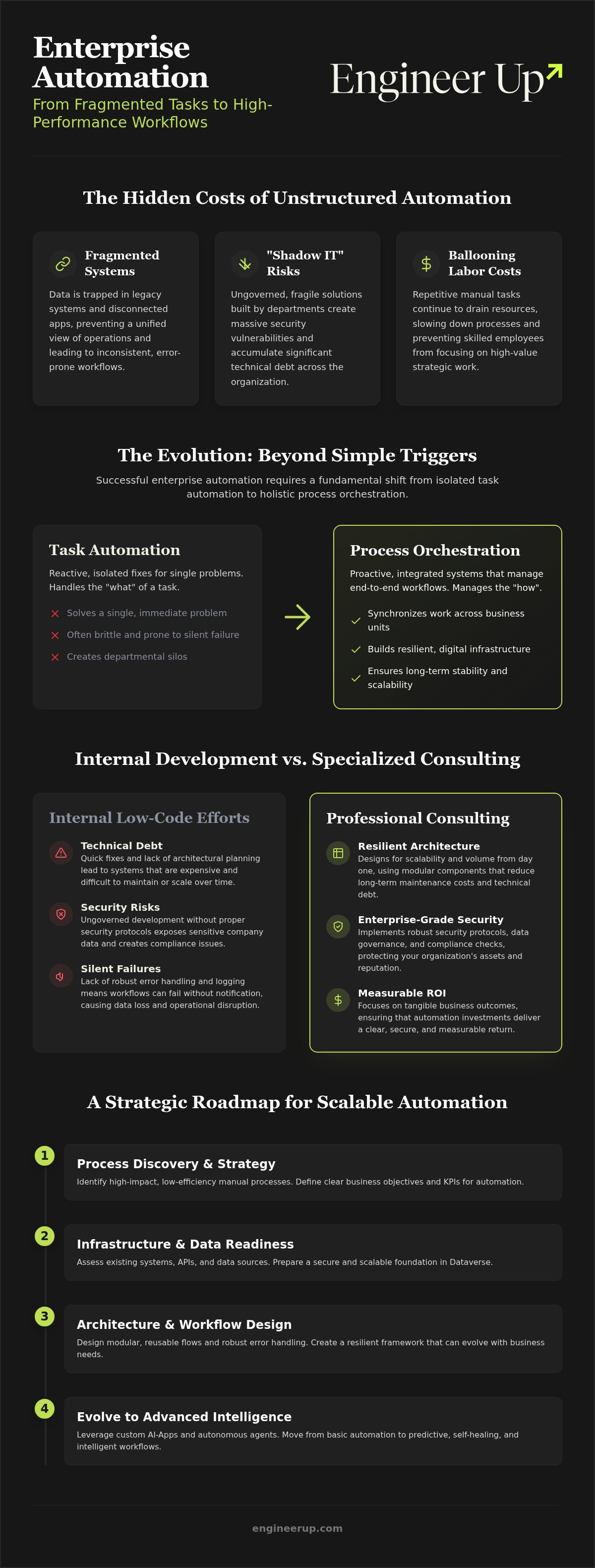
A Strategic Roadmap for Scalable Enterprise Automation
Scaling enterprise automation isn't a matter of luck. It's a matter of architecture. Effective power automate consulting provides the methodical structure necessary to navigate complex deployments without creating technical debt. You need a path that moves from initial discovery to long-term governance with total clarity.
Phase 1 begins with comprehensive process discovery. You must map value before you build. Phase 2 requires an infrastructure and security readiness assessment to ensure your environment can support high transaction volumes. Phase 3 focuses on the Minimum Viable Automation (MVA). This stage proves ROI quickly by targeting a high-impact, low-risk process. Phase 4 involves full-scale deployment and deep integration with your existing tech stack. Finally, Phase 5 establishes an Automation Center of Excellence (CoE). A CoE ensures that your standards, security protocols, and development practices remain consistent as you scale.
Evaluating Infrastructure and Data Readiness
Infrastructure readiness is the primary differentiator between successful projects and expensive failures. You must audit legacy systems for API availability and modern connectivity. Relying on fragile workarounds for systems that lack APIs creates a maintenance nightmare. Data cleanliness is equally critical. Automating a data-heavy workflow with "dirty" or inconsistent data only accelerates the production of errors. You need to identify bottlenecks that software alone cannot solve. Sometimes a process requires structural redesign before it's ready for digital logic. Professional consulting identifies these gaps early.
Measuring ROI and Operational Impact
Define KPIs that reflect actual business value. "Hours saved" is a surface-level metric that often ignores the cost of maintenance. You need to track error reduction, throughput speed, and resource utilization. Monitoring the long-term impact of business process automation services allows for continuous refinement. Use data-driven insights to optimize existing flows and eliminate redundant steps. High-performance systems are never static. They evolve based on execution telemetry and changing business priorities.
If you want a roadmap that delivers elite reliability and tangible results, engage with Engineer Up for professional automation strategy consulting. We build the frameworks that turn complex technical challenges into measurable competitive advantages.
Engineer Up: High-Performance Power Automate Solutions
Engineer Up delivers high-performance power automate consulting designed for organizations that demand technical mastery. We don't offer generic IT support or hardware sales. We specialize in the Microsoft ecosystem to build custom AI-Apps and autonomous agents. Our engagement model is direct. We focus on tangible business outcomes rather than decorative reports. We assume the burden of complex technical challenges so you can focus on your primary goals. This elite specialization ensures that your digital infrastructure is built to a professional standard from day one.
Our process covers the entire lifecycle of an automation project. It starts with strategy consulting to map your objectives and identify high-value opportunities. It moves through bespoke development and into ongoing support. This end-to-end delivery ensures that your digital infrastructure remains stable and high-performing. We bridge the gap between fragmented manual processes and enterprise-grade workflows. You gain a partner that values technical precision and transparent communication above all else.
Custom AI Agent Integration
Static triggers are often insufficient for modern requirements. High-performance systems require intelligent, decision-making agents. We provide enterprise AI agent consulting to help you move beyond simple "if-this-then-that" logic. These agents analyze real-time data to make autonomous choices within your established governance framework. They don't just follow a path; they navigate it based on the context of the data they process.
In finance, these agents handle complex reconciliation across multiple accounts without manual intervention. They identify discrepancies and route them for approval based on risk thresholds. In operations, they optimize supply chain logistics by predicting delays and adjusting triggers dynamically. We bridge the technical gap between standard Power Automate flows and sophisticated AI models. This integration turns your automation platform into a proactive business asset that drives competitive advantage.
Ongoing Strategic Support for Continuous Growth
Automation is not a one-time event. It requires continuous evolution to stay aligned with your business requirements. We provide proactive monitoring and performance tuning for all mission-critical flows. This prevents degradation and ensures your systems handle increasing transaction volumes with ease. Our ongoing support model is built for stability. We identify potential bottlenecks before they impact your throughput, maintaining a state of constant optimization.
Technical mastery means anticipating changes in the Microsoft ecosystem before they impact your operations. We don't just fix what's broken. We architect for elite reliability. Our team ensures your automations remain secure and compliant as governance standards evolve toward 2026 and beyond. Contact Engineer Up to engineer a high-performance automation framework that delivers measurable business value and operational excellence.
Architecting for Elite Operational Performance
Transitioning from fragmented manual tasks to enterprise-grade workflows requires more than just low-code tools. It demands a strategic foundation built on security, scalability, and technical precision. Professional power automate consulting eliminates the risks of Shadow IT and technical debt, replacing fragile patches with resilient, autonomous systems. This evolution ensures your architecture remains stable even as transaction volumes increase and business requirements shift. By integrating custom AI agents and robust process orchestration, you turn the Microsoft ecosystem into a high-performance engine for growth.
Partner with Engineer Up for elite Power Automate consulting and enterprise-grade automation. We provide a boutique specialization in the Microsoft Power Platform, focusing on high-performance AI and automation outcomes. Our proven framework for scaling enterprise workflows securely assumes the technical burden so you can focus on your primary business goals. It's time to move beyond basic triggers and toward a future of intelligent, self-governing automation that drives measurable competitive advantage. Your organization is ready for a digital infrastructure that works as hard as you do.
Frequently Asked Questions
What is the primary benefit of Power Automate consulting for large businesses?
The primary benefit is the transition from fragmented, manual processes to high-performance, enterprise-grade architecture. While internal teams often build isolated triggers, professional power automate consulting ensures that your workflows are scalable, secure, and fully integrated with your broader digital strategy. This approach eliminates technical debt and ensures that your automation framework supports long-term business objectives rather than just solving immediate, reactive problems. You gain a stable, structural asset that delivers elite operational reliability.
How does professional consulting mitigate the risks of Shadow IT?
Consultants mitigate Shadow IT by establishing a formal governance framework that centralizes control without stifling departmental innovation. We implement strict Data Loss Prevention (DLP) policies at the environment level to restrict unauthorized data movement. This professional oversight ensures that all low-code development follows established security protocols and architectural standards. By providing a structured path for automation, you eliminate the need for employees to build fragile, ungoverned workarounds that put your enterprise data at risk.
Can Power Automate integrate with legacy systems that lack modern APIs?
Power Automate integrates with legacy systems through UI-based Desktop flows, commonly known as Robotic Process Automation (RPA). This technology allows the platform to interact with older software that lacks modern APIs by mimicking human actions on the screen. Specialized consultants bridge these technical gaps by architecting hybrid solutions that connect legacy on-premises data with modern cloud applications. This ensures your existing investments continue to deliver value while you modernize your broader digital infrastructure and workflows.
What is the typical ROI timeframe for an enterprise Power Automate project?
Enterprise automation projects typically deliver a measurable ROI within three to six months of full deployment. By focusing on a Minimum Viable Automation (MVA) in the initial phase, organizations can prove value and recover implementation costs quickly through reduced error rates and increased throughput. The timeline depends on process complexity and data readiness. Professional power automate consulting accelerates this timeframe by utilizing proven frameworks and avoiding the trial-and-error phase common in amateur internal development projects.
How do consultants ensure the security of automated data transfers?
Security is maintained through a multi-layered approach that leverages the native security features of the Microsoft Power Platform. Consultants configure identity management through Azure Active Directory and ensure all data transfers utilize industry-standard encryption protocols. We also utilize Dataverse as a secure, centralized data foundation to prevent the risks associated with storing sensitive information in external spreadsheets. This ensures that every automated process complies with your organization's broader security and data privacy requirements.
Does Power Automate consulting include training for internal staff?
Specialized consulting often includes a strategic focus on establishing an Automation Center of Excellence (CoE) to empower your internal teams. This involves standardizing development practices and providing the technical documentation necessary for your staff to maintain and update flows. While the consultant handles the complex architectural challenges, your internal team learns to manage day-to-day operations within a secure, governed framework. This approach ensures long-term self-sufficiency and continuous improvement of your automation assets without ongoing external reliance.
How does Power Automate work with custom AI agents and applications?
Power Automate serves as the execution engine for custom AI agents and applications. When an AI agent identifies a required action, it triggers a flow to move data, send notifications, or update records across the Microsoft ecosystem. This integration allows for autonomous decision-making within your workflows. Consultants build the connectors and logic paths that allow your custom AI models to interact seamlessly with your existing business applications, turning static processes into intelligent, self-adjusting systems.
What is the difference between Power Automate and traditional RPA?
Traditional RPA focuses almost exclusively on mimicking human interactions with user interfaces to automate repetitive tasks. Power Automate is a broader platform that combines this UI-based automation with API-led cloud flows and deep integration with the Microsoft 365 stack. This holistic approach allows for more resilient and faster automations by using direct data connections whenever possible. It moves beyond simple bot-based task execution to provide a comprehensive framework for enterprise-wide process orchestration and intelligent digital logic.
WRITTEN BY
Get Your Team AI Ready
Let's hear your use case - we'll help you get on the path to AI readiness.

FILED UNDER
TOOLS IN THIS POST

