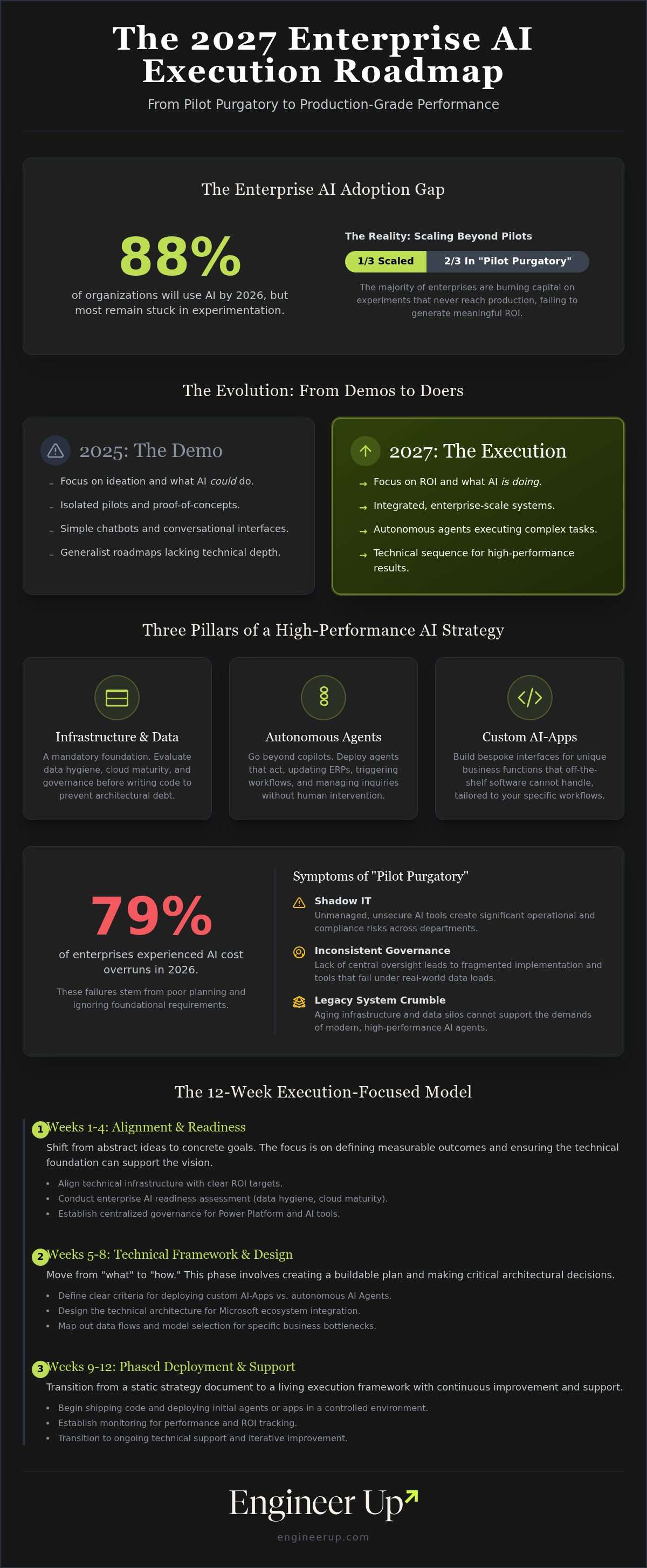
88% of organizations use AI in 2026. Only one-third have scaled it beyond isolated pilots. Most enterprises are currently trapped in pilot purgatory, burning capital on experiments that never reach production. You likely recognize the symptoms. Inconsistent governance leads to shadow IT. Legacy systems crumble under the weight of modern AI agents. This isn't a technology problem; it's an execution failure. Professional enterprise ai roadmap consulting is no longer about ideation. It's about engineering a technical sequence for high-performance results.
We agree that your business deserves more than a slide deck. You need a buildable plan. This guide ensures you master the transition from AI experimentation to enterprise-scale performance using our 2027 execution-focused roadmap template. We'll strip away the hype to focus on tangible output. You'll get a structured deployment timeline, clear criteria for choosing between custom apps and autonomous agents, and a technical framework for Microsoft ecosystem integration. It's time to stop talking and start shipping code that moves the needle.
Key Takeaways
• Shift from experimental pilots to production-grade performance by aligning technical infrastructure with clear ROI targets.
• Utilize specialized enterprise ai roadmap consulting to move from generalist strategy to a phased, 12-week execution model.
• Define clear criteria for deploying custom AI-Apps versus autonomous AI Agents to solve specific business bottlenecks.
• Eliminate shadow IT by implementing centralized governance for Power Platform and modernizing legacy manual processes.
• Transition from a static strategy document to a living execution framework backed by ongoing technical support.
The Evolution of Enterprise AI Roadmaps: From Pilots to Performance
The 2025 landscape was defined by experimentation. It was the year of the demo. 2026 is different. It's defined by ROI and scale. Organizations no longer care about what AI could do; they care about what it is doing for the bottom line. This transition requires specialized enterprise ai roadmap consulting that bridges the gap between executive vision and technical execution. Generalist roadmaps frequently fail because they lack technical depth. They offer high-level advice but ignore infrastructure readiness and data architecture.
We're witnessing a fundamental shift from "Chatbots" to "Autonomous Agents." Simple conversational interfaces are being replaced by agents that execute complex business tasks. These systems don't just answer questions; they interact with your existing software stack to solve problems. To succeed, your organization needs a robust Technology strategy that treats AI as a unified enterprise fabric. Isolated pilots are liabilities. Integrated systems are assets.
Identifying Pilot Purgatory
Pilot purgatory is the graveyard of enterprise innovation. It's characterized by stalled initiatives and inconsistent governance. You've likely seen the symptoms. A department builds a tool that works in a vacuum but fails when exposed to real-world data or security requirements. This lack of cohesion leads to shadow IT, where unmanaged AI tools create significant operational risk. For organizations managing these risks during complex financial transitions, Swiss Alpha Matrix offers the specialized due diligence required to protect enterprise assets. The cost of inaction is high, but fragmented implementation is more expensive. Off-the-shelf solutions rarely meet the needs of unique enterprise workflows. High-performance execution requires custom AI-Apps and Agents designed for your specific operational constraints.
Strategic planning must start with measurable outcomes. Don't select a model until you've identified the revenue driver it will support. Whether it's reducing churn or automating supply chain logistics, the goal must be clear. Building for 2027 requires anticipating the next wave of agentic capabilities now. This means preparing your Microsoft ecosystem for deep integration and autonomous task handling. A roadmap isn't a static document. It's a technical sequence. We focus on the "doer" mentality, ensuring your strategy results in shipped code and stable systems that deliver a clear return on investment.
Core Pillars of a Modern AI Strategy: Infrastructure, Agents, and Apps
A high-performance strategy rests on three technical pillars: infrastructure, agents, and custom apps. Successful enterprise ai roadmap consulting identifies these dependencies early to prevent expensive architectural debt. 79% of enterprises experienced AI cost overruns in 2026. Most of these failures stem from ignoring the foundational requirements of high-scale deployment. You cannot expect modern AI agents to perform on top of fragmented, low-quality data silos.
Infrastructure and Data Foundation
You can't build a skyscraper on a swamp. Comprehensive enterprise ai readiness consulting is the mandatory prerequisite for any roadmap. It evaluates data hygiene and cloud maturity before a single line of code is written. Legacy systems shouldn't be anchors. We bridge the gap by integrating aging data silos with modern large language models. Effective data governance acts as a performance multiplier. It ensures your models are fueled by clean, authoritative data while maintaining strict compliance with the EU AI Act and local transparency laws.
The Role of Custom AI Agents
Standard copilots offer generic productivity. They summarize meetings and draft emails. For deep business value, you need autonomous entities. Our approach to enterprise ai agent consulting focuses on systems that interact with Line of Business (LOB) software. These agents don't just talk; they act. They update ERP records, trigger supply chain workflows, and manage complex customer inquiries without human intervention. Knowing when to build custom agents versus using standard tools is critical for achieving a measurable return on investment.
Consider these criteria for your 2026 roadmap:
Custom AI-Apps
Build these when you need a bespoke interface for a unique business function that off-the-shelf software cannot handle.
Autonomous Agents
Deploy these for complex, multi-step tasks that require deep system-level interaction and decision-making capabilities.
Security Frameworks
Implement centralized governance within the Microsoft ecosystem to stop shadow IT and protect intellectual property.
A secure foundation allows your team to innovate without risking data privacy or crossing regulatory boundaries. If your current plan feels like a generic template rather than a technical blueprint, connect with our execution specialists to build a plan that actually works. We focus on turning strategy into shipped code that delivers tangible business outcomes.
The 2027 Enterprise AI Roadmap Template: A Phased Execution Model
Theory is cheap. Execution is expensive. Most strategic plans fail because they lack a clear timeline for technical delivery. Our enterprise ai roadmap consulting methodology replaces vague goals with a rigorous, four-phase execution model. We prioritize shipping usable code over generating abstract reports. This template ensures your organization moves from initial discovery to enterprise-scale performance in under six months.
Phase 1-2: From Discovery to MVP
Weeks 1 through 4 focus on discovery and readiness. We don't start with models; we start with your business processes. We inventory every manual workflow that creates operational friction. This phase identifies exactly where automation provides the highest return. We assess your data hygiene to ensure your foundation can support high-performance agents without hallucination or security leaks.
Weeks 5 through 12 transition into architecture and MVP development. We select the tech stack based on your existing infrastructure and long-term goals. For the majority of enterprises, this means leveraging Microsoft Azure and the Power Platform for rapid deployment. If your requirements are highly specialized, we build custom Python environments. Every project has a fixed ship date. We don't tolerate scope creep or perpetual development cycles. The goal is to get a functional, high-performance pilot into the hands of your users as quickly as possible.
Phase 3-4: Hardening and Scaling
Weeks 13 through 20 involve hardening and governance. We integrate custom ai app development for business into the fabric of your daily operations. This phase ensures your systems are resilient and secure. We establish an AI Center of Excellence (CoE) to centralize governance. This body manages model access, monitors security compliance, and prevents the rise of shadow IT across different departments. It's about building a trusted environment where innovation doesn't compromise data privacy.
From week 21 onward, the focus shifts to scaling and ongoing performance support. High-performance AI isn't a one-time project; it's a continuous optimization loop. We measure success by tracking operational efficiency gains against implementation costs. This data-driven approach allows us to refine your agents and apps based on real-world usage. Key activities in this final phase include:
Performance Monitoring
Tracking model accuracy and system latency in production.
ROI Audits
Quantifying hours saved and revenue generated by AI initiatives.
Agent Optimization
Refining autonomous task execution based on user feedback.
Governance Reviews
Ensuring compliance with the latest 2026 regulatory updates.
A roadmap is a living document. It must evolve as your technical maturity increases. By following this phased model, you ensure that every dollar spent on AI strategy results in a tangible business outcome.
Navigating Implementation: Scaling Power Platform and Custom Agents Securely
Implementation is where roadmaps meet operational reality. Scaling within the Microsoft ecosystem requires more than just technical connectivity; it demands a rigid security posture. Effective enterprise ai roadmap consulting must address the proliferation of unmanaged tools. Shadow IT thrives when departments feel the central IT response is too slow. We stop this by implementing centralized governance for low-code tools. This ensures every automation is visible, managed, and secure. Every tool must serve the broader business objective without creating new vulnerabilities.
Replacing legacy Excel processes is a priority for 2026. Manual spreadsheets are brittle. They lack audit trails. We migrate these fragmented workflows into secure Power Apps that live inside your authenticated environment. Integrating custom AI agents into Microsoft Teams and SharePoint makes these tools accessible where your staff already works. Performance is non-negotiable. We ensure stability through business process automation services that focus on long-term reliability over temporary fixes.
Power Apps Strategy for Enterprise
Sprawl is the enemy of efficiency. Our power apps consulting services prevent platform fragmentation by establishing clear development standards. We implement security protocols that protect sensitive business data while allowing for rapid innovation. This includes strict Data Loss Prevention (DLP) policies and environment routing. We also prioritize training your internal teams for sustainable management. High-performance standards must be maintained long after the initial deployment concludes.
Agentic Workflow Integration
Custom agents must do more than summarize text. They need to connect to your legacy databases securely. We develop department-specific copilots that handle high-volume productivity tasks with precision. Monitoring is vital for production systems. Production environments often face "hallucination drift" where model accuracy degrades over time. Our frameworks include automated testing and feedback loops to maintain output quality. Gartner forecasts that 40% of enterprise applications will have embedded AI agents by the end of 2026. We ensure your agents are part of that percentage without compromising your security perimeter.
If your organization is ready to move from planning to production, schedule an implementation review with our engineers. We focus on shipping secure, high-performance code that scales with your business needs.
Beyond the Roadmap: Why Execution Beats Strategy
A roadmap is a living document. It isn't a static archive to be filed away after a single board meeting. High-performance AI requires constant attention and iterative refinement. Professional enterprise ai roadmap consulting must include a plan for the entire system lifecycle. You need to manage AI agents from their initial concept through to their eventual retirement. Partnering with an execution-focused firm or the expertise of Vygandas Pliasas allows your leadership to offload the heavy technical burden. We focus on the precision of the build so you can focus on the direction of the business.
AI applications require significantly more maintenance than traditional software. It's a fundamental reality of the 2026 tech stack. Models drift. Data sources shift. Security protocols must evolve to meet new regulatory standards like the EU AI Act. Managed services for enterprise AI are no longer optional if you want to keep systems optimized. You can't simply deploy an agent and walk away. As LLM capabilities shift in 2027, your roadmap must adapt to incorporate new agentic efficiencies. We provide the ongoing technical support necessary to maintain these elite performance standards.
Finalizing Your 2027 Plan
Your 2027 plan should prioritize three things: speed, security, and scale. Start by auditing your current data hygiene. If your data foundation is weak, your AI output will be unreliable. Identify the manual processes that currently drain your team's productivity. These are your first targets for automation. Professional enterprise ai roadmap consulting provides the blueprint, but your organization must provide the momentum to start the build. Immediate next steps include establishing your AI Center of Excellence and finalizing your 12-week MVP timeline.
The window for experimentation is closing. The market now rewards those who can move from theory to production-grade results. Don't let your strategy become a bottleneck. Execute your enterprise AI roadmap with Engineer Up today. We specialize in turning complex technical challenges into stable, high-performance business assets.
Transitioning from Strategy to Scalable Execution
AI is no longer a sandbox for experimentation. It's a core engine for operational performance. Success in 2026 requires more than a vision; it requires a technical blueprint that prioritizes secure infrastructure and autonomous agentic workflows. By following a phased roadmap, you move from discovery to production without the risk of pilot purgatory. High-performance execution demands a commitment to data hygiene and centralized governance within your Microsoft environment. This ensures your systems are stable, scalable, and fully compliant with evolving global regulations.
Professional enterprise ai roadmap consulting ensures your technical debt remains low while your output remains high. As Microsoft ecosystem specialists, we assume the technical burden so you can focus on growth. We provide custom agentic AI expertise and a relentless focus on end-to-end execution. This approach transforms a static strategy into a living, high-performance system. Build and Execute Your High-Performance AI Roadmap with our team of engineers. Your enterprise transformation is buildable. It's time to ship code that delivers results.
Frequently Asked Questions
What is an enterprise AI roadmap and why is it necessary in 2026?
An enterprise AI roadmap is a technical blueprint that transitions an organization from experimentation to production-grade performance. In 2026, it's necessary because 88% of organizations use AI, but only one-third have scaled beyond isolated pilots. Without a clear sequence, companies risk high cost overruns and fragmented governance. Professional enterprise ai roadmap consulting provides the structure needed to align infrastructure, security, and business objectives. It's the best way to ensure long-term ROI.
How long does it take to develop a custom AI roadmap for a mid-size enterprise?
Developing a comprehensive roadmap typically requires four weeks of intensive discovery and readiness assessment. This initial phase identifies high-impact workflows and evaluates data hygiene. While the strategy is established quickly, the full transition to an MVP and subsequent scaling usually occurs over a 20-week execution model. It's a timeline that ensures technical architecture is sound and governance protocols are in place before broad deployment across the enterprise, preventing expensive architectural debt later.
Can we integrate custom AI agents with our existing legacy systems?
Yes, custom AI agents can and should integrate with legacy systems to provide real business value. We specialize in bridging the gap between aging data silos and modern large language models using the Microsoft ecosystem. These agents don't just generate text; they interact with Line of Business software to update records and trigger workflows. It's an integration that transforms stagnant data into an active asset while maintaining the stability of your core infrastructure.
How do we manage the risk of Shadow IT when scaling the Power Platform?
Managing shadow IT requires implementing a centralized governance framework within the Power Platform. We establish strict Data Loss Prevention policies and environment routing to ensure all automations remain visible and managed. By providing clear development standards and training internal teams, you don't risk platform sprawl or unauthorized tool creation. It's an approach that allows for rapid innovation while maintaining a high degree of control over sensitive business data and intellectual property.
What is the difference between AI strategy consulting and execution-focused consulting?
Strategy consulting focuses on high-level ideation and theoretical frameworks, often resulting in abstract slide decks. Execution-focused consulting, which we prioritize, is about shipping usable code and stable systems. While strategy defines the "what," execution delivers the "how." We act as the "doer" because we don't just talk about potential. We assume the technical burden of building custom AI-Apps and Agents to ensure your roadmap results in tangible business outcomes rather than stalled initiatives.
How do we measure the ROI of our enterprise AI roadmap initiatives?
ROI is measured by comparing operational efficiency gains against the total cost of implementation. We track specific metrics like hours saved through automated task execution and the EBIT impact of AI-driven revenue drivers. Since only 39% of organizations currently report an EBIT impact from AI, we focus on high-impact business processes. Regular ROI audits allow us to refine agents and apps based on real-world usage data. It's a data-driven approach to performance support.
What role does data governance play in an AI roadmap?
Data governance acts as a performance multiplier by ensuring that AI models are fueled by clean, authoritative data. It's a critical pillar of any roadmap because it prevents "hallucination drift" and ensures compliance with 2026 regulations like the EU AI Act. Proper governance manages data access and privacy while providing the foundation for high-performance agentic workflows. It's the only way to ensure your advanced AI agents don't fail to deliver reliable results in production.
Why should we choose a boutique firm for AI roadmap consulting over a global agency?
Boutique firms offer specialized technical depth and a direct focus on tangible outcomes that global agencies often lack. We provide elite reliability within the Microsoft ecosystem, focusing on custom AI Agents and bespoke App development. Choosing a boutique partner for enterprise ai roadmap consulting means working with a dedicated force that assumes the technical burden of execution. It's a no-nonsense approach that prioritizes efficiency and technical mastery over decorative language or superficial marketing buzzwords.
WRITTEN BY
Get Your Team AI Ready
Let's hear your use case - we'll help you get on the path to AI readiness.

FILED UNDER
TOOLS IN THIS POST

