Most enterprise chatbots are nothing more than glorified search bars that hallucinate when the stakes are high. They offer generic answers that ignore your specific operational logic and security requirements. You've likely seen the risks of data leakage and the friction of trying to force modern AI into rigid legacy software. These tools become liabilities. It's time to demand more from your technology stack.
Reliability requires a system built for tangible outcomes. This article demonstrates how custom AI chat agents for enterprise move beyond basic text generation to automate complex workflows and integrate with legacy data. We'll provide a technical deep dive into agentic AI architecture, showcase real-world examples of operational efficiency, and outline a secure roadmap for deployment. You'll learn how to transform AI from a conversational toy into a robust engine for business growth. We focus on the architecture that drives results.
Key Takeaways
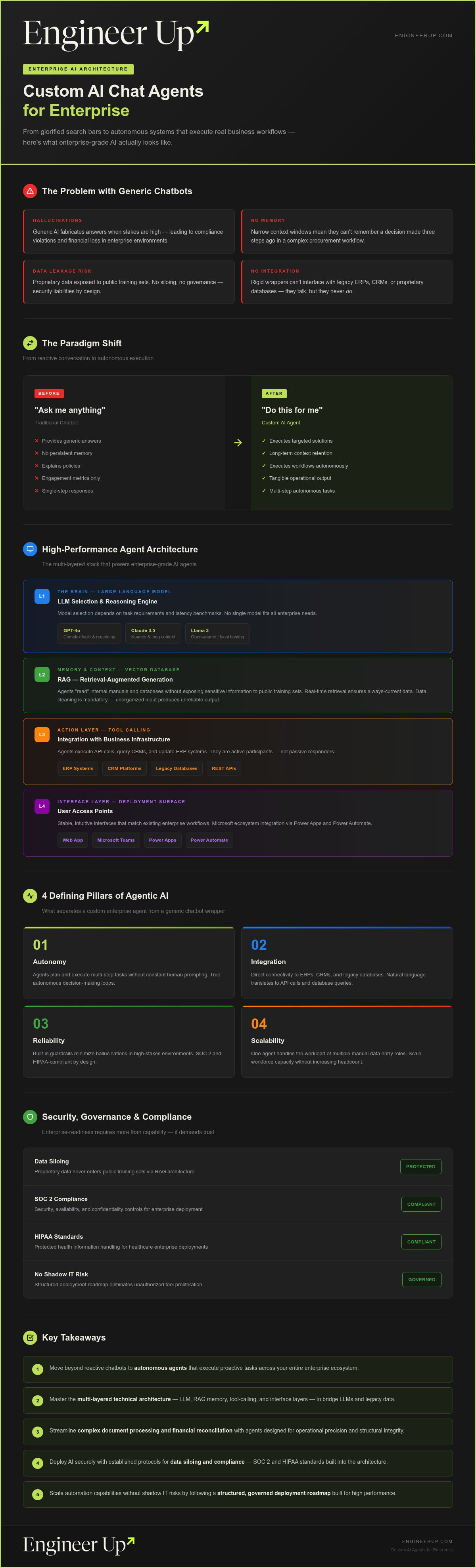
• Move beyond reactive chatbots to autonomous agents that execute proactive tasks across your enterprise ecosystem.
• Master the technical architecture of custom ai chat agents for enterprise to bridge the gap between LLMs and legacy data.
• Streamline complex document processing and financial reconciliation with agents designed for operational precision and structural integrity.
• Deploy AI securely with established protocols for data siloing and compliance with SOC 2 and HIPAA standards.
• Scale your automation capabilities without the risks of shadow IT by following a structured, high-performance deployment roadmap.
Beyond Basic Chatbots: The Evolution of Enterprise AI Agents
The era of the simple conversational interface is ending. In 2026, the enterprise landscape has shifted from basic chatbots to autonomous systems that perform actual labor. Standard chatbots provide answers; custom ai chat agents for enterprise provide solutions. This evolution represents a move from reactive text generation to proactive task execution. It isn't just about better language. It's about agency. Enterprises are abandoning generic wrappers because they lack the structural integrity needed for real business labor.
The Limitations of Traditional Conversational AI
Traditional AI often hits a wall when faced with complex, multi-step workflows. These systems rely on narrow context windows and lack persistent memory. They can't remember a decision made three steps ago in a procurement process. For enterprise finance and legal departments, the risk is even higher. Hallucinations aren't just minor errors. They are structural failures that can lead to compliance violations or financial loss. Generic wrappers don't have the safeguards required to handle proprietary data or legacy software integration safely. They remain stuck in a loop of "talking" without "doing."
Defining Agentic AI for the Modern Enterprise
Agentic AI is a goal-oriented system capable of autonomous tool-calling and decision-making to complete specific business objectives. The paradigm has shifted from "Ask me anything" to "Do this for me." Modern custom ai chat agents for enterprise function as intelligent middleware. They sit between your users and your legacy systems. They translate natural language into API calls, database queries, and document updates. This is the difference between a bot that explains a policy and an agent that executes a workflow based on that policy.
The impact on operational efficiency is measurable. By replacing manual legacy workflows with autonomous agents, organizations can scale their workforce without increasing headcount. They move beyond the limitations of shadow IT and the fragility of manual spreadsheets. This transition allows teams to focus on strategic outcomes while the agent handles the heavy lifting of data reconciliation and process management. It's about building a system that works as hard as your best performers. The focus is on tangible output, not just engagement metrics.
Autonomy
Agents plan and execute multi-step tasks without constant human prompting.
Integration
They connect directly to ERPs, CRMs, and legacy databases.
Reliability
Built-in guardrails minimize hallucinations in high-stakes environments.
Scalability
One agent can handle the workload of multiple manual data entry roles.
The Architecture of a High-Performance Custom AI Agent
Building custom ai chat agents for enterprise requires more than a simple API connection to a language model. It demands a multi-layered architecture designed for precision. The "Brain" is your Large Language Model (LLM). While GPT-4o offers superior reasoning for complex logic, Claude 3.5 excels in nuance, and Llama 3 provides a robust open-source alternative for local hosting. Selecting the right model depends entirely on specific task requirements and latency benchmarks. High-performance systems don't rely on model intelligence alone. They utilize sophisticated memory systems and vector databases to ensure long-term context retention and factual accuracy.
Action is the core of agency. Modern custom ai chat agents for enterprise use tool-calling to interact with your business infrastructure. They aren't just reading text; they are executing API calls, querying CRMs, and updating ERP systems. This functionality transforms the agent into an active participant in your operations. The interface must match the workflow. Whether deployed through a web app, Microsoft Teams, or custom Power Apps, the goal remains the same: provide a stable, intuitive access point for users to engage with complex automation.
Retrieval-Augmented Generation (RAG) and Proprietary Data
RAG is the standard for secure data utilization. It allows your agent to "read" internal manuals and databases without exposing sensitive information to public training sets. Accuracy depends on the quality of your input. Data cleaning is mandatory. Feeding unorganized or outdated information into an agent results in unreliable output. Real-time retrieval ensures the agent always references the most current data, making it far more effective than static model training for environments where information changes daily.
Integration with the Microsoft Ecosystem
For many organizations, the Microsoft stack provides the ideal foundation. Custom agents leverage Power Apps consulting services to create professional, governed user interfaces. Power Automate serves as the nervous system, carrying out the agent's decisions across various applications. This approach effectively bridges the gap between legacy Excel processes and intelligent AI interfaces. It replaces fragile spreadsheets with robust, autonomous workflows that scale without creating shadow IT risks. Organizations looking to professionalize their AI strategy often benefit from expert strategy consulting to align these tools with business goals.
Enterprise Use Cases: Custom AI Agents in Action
Most market discourse focuses on customer support bots. This ignores the highest-value application for custom ai chat agents for enterprise: internal operational efficiency. While basic chatbots handle surface-level inquiries, true agents execute labor-intensive tasks within supply chains, finance departments, and executive offices. They act as an autonomous layer that bridges the gap between raw data and decisive action. These systems don't just talk. They work.
In finance, agents reconcile complex invoices against purchase orders and shipping manifests. They identify margin errors and duplicate billings that manual audits often miss. For executive leadership, agents synthesize board reports by pulling real-time data from disparate sources, including CRM metrics and live ERP feeds. This reduces the time spent on report preparation from days to seconds. The focus remains on structural integrity and verifiable output.
Supply Chain and Logistics Automation
Logistics operations face a constant burden of paperwork and tracking. A custom agent can manage customs documentation and carrier tracking autonomously. One implementation demonstrated a 90% reduction in manual entry errors through agent-led verification. By integrating directly with legacy ERPs, these agents provide real-time inventory predictions and alert managers to potential stock-outs before they occur. They handle the heavy lifting of data entry so logistics professionals can focus on strategic routing and carrier negotiations. This is high-performance automation in a physical world context.
Internal Productivity and the Digital Co-Worker
The "digital co-worker" model transforms internal support. Instead of waiting for a human response, employees interact with agents for IT troubleshooting and HR policy queries. This moves the organization away from fragmented "Shadow IT" and toward a governed, centralized AI strategy within the Microsoft ecosystem. It represents a critical transition from custom ai app development for business to comprehensive agent-led workflows. These systems provide a first line of defense, resolving routine issues and escalating only the most complex cases to human staff.
Procurement
Agents manage vendor communication and automate RFQ (Request for Quote) processing.
Human Resources
Autonomous onboarding agents guide new hires through documentation and training modules, providing a digital layer that complements professional California PEO services for end-to-end workforce management.
Legal
Agents perform initial contract reviews, highlighting clauses that deviate from company standards.
IT Operations
Real-time monitoring agents identify system anomalies and initiate automated recovery protocols.
Sales and Marketing
Specialized platforms like SocialPosterr utilize agentic AI to manage multi-channel social media and qualify leads, transforming engagement into measurable business growth.
Scaling these capabilities requires a commitment to technical mastery. It isn't enough to deploy a tool. You must architect a system that understands your business logic. By utilizing the Power Platform and specialized AI-Apps, enterprises can build a workforce of agents that maintain high-performance standards around the clock. This is how modern organizations assume the burden of technical complexity to remain focused on their primary objectives.
Security, Governance, and Enterprise Readiness
Security is the primary barrier to AI adoption. For custom ai chat agents for enterprise, a single data leak can negate years of operational gains. Reliability starts with data siloing. Agents must respect existing permission layers. If a user doesn't have access to a specific SharePoint folder or SQL database, the agent shouldn't either. This requires a robust middleware layer that enforces identity and access management (IAM) at every turn. We don't just build interfaces. We build secure perimeters.
Compliance is non-negotiable. Designing for SOC 2, HIPAA, and GDPR requires technical mastery. It isn't just about encryption. It's about data residency and right-to-be-forgotten protocols. Every decision an agent makes must be logged. Monitoring and auditing provide the accountability needed for high-stakes environments. If an agent reconciles an invoice incorrectly, you need a clear paper trail to identify the failure point. Accountability is the hallmark of professional automation.
High-performance systems incorporate Human-in-the-Loop (HITL) triggers. Agents shouldn't operate in a vacuum. They must recognize their own confidence thresholds. When a task exceeds a specific risk profile or complexity level, the system must escalate to a person. This ensures that autonomous agents remain tools for efficiency rather than sources of liability. It's about augmenting human talent, not bypassing human judgment.
The Enterprise Governance Framework
A structured enterprise ai agent consulting engagement establishes the necessary guardrails for deployment. This framework prevents common vulnerabilities like prompt injection and unauthorized data exfiltration. It defines the roadmap for moving from a pilot phase to full-scale production. Prioritize security over speed. A system that is fast but insecure is fundamentally broken. We build for structural integrity from day one, ensuring that your AI roadmap is both ambitious and safe.
Scaling Without Shadow IT
Centralized development is the only way to manage risk. When departments build their own siloed bots, they create "Shadow IT" that bypasses corporate security. Managing the lifecycle of custom ai chat agents for enterprise requires a unified approach. This includes everything from the initial prototype to ongoing support and maintenance. Rigorous testing and evaluation ensure that technical performance remains high as models evolve. Organizations that value stability choose a partner capable of assuming the burden of these technical challenges. If you're ready to secure your AI future, explore our strategy consulting services to align your roadmap with enterprise standards.
Strategic Implementation: Partnering for Performance
Generalist agencies often fail at the integration layer. They provide surface-level solutions that collapse when faced with complex legacy data. High-performance automation requires more than a standard API call. It demands technical mastery of your specific business logic. Boutique consulting firms offer the specialized focus necessary for custom ai chat agents for enterprise to function as reliable operational layers. We assume the burden of technical complexity so you can focus on primary objectives. Results depend on the quality of the engineering, not the volume of the marketing.
Stability is the priority. We focus on the Microsoft ecosystem because it provides the structural integrity enterprises require. By utilizing Power Apps and the broader Power Platform, we transform fragile, manual processes into robust, autonomous systems. This transition replaces legacy Excel workflows with intelligent applications that scale without creating security risks. Our approach is grounded in tangible outcomes. We don't build toys; we build engines for business growth.
From Concept to Deployment
The discovery phase identifies the workflows with the highest ROI. We don't automate for the sake of novelty. We target the specific bottlenecks that drain resources and introduce error. Our prototyping process connects agents directly to your existing data silos, ensuring they respect your operational constraints. This isn't a generic implementation. It's a bespoke architectural build. Final deployment focuses on technical uptime and user adoption, ensuring the system delivers value from day one. Every step is methodical and results-oriented.
Ongoing Technical Support and Optimization
Deployment is just the beginning. AI agents require continuous monitoring to maintain peak performance standards. As business processes evolve and legacy systems update, your agents must adapt. We provide ongoing support to prevent accuracy degradation and ensure your automation remains aligned with your strategic goals. This commitment to maintenance is what separates a successful deployment from a failed experiment. High-performance systems demand high-performance care. It's time to professionalize your AI strategy. Consult with Engineer Up for your enterprise AI agent strategy and move beyond conversational toys to actual operational labor.
Discovery
Pinpointing high-impact automation targets.
Architecture
Designing secure, Microsoft-aligned frameworks.
Development
Building intelligent AI-Apps that replace manual labor.
Support
Providing the technical maintenance required for long-term stability.
Technical performance is the only benchmark that matters. By partnering with a specialized force, you ensure that your custom ai chat agents for enterprise are built to last. We focus on the heavy lifting of data integration and security protocols. You receive a system that works. The difference is in the engineering.
Architecting Your Autonomous Future
The transition from reactive chatbots to proactive agents is now a requirement for operational efficiency. High-performance custom ai chat agents for enterprise bridge the gap between legacy data and executive action. Success depends on a secure architecture that prioritizes structural integrity and technical mastery. You've seen how these systems automate supply chains, reconcile finance data, and scale internal support within a governed Microsoft ecosystem. These aren't just tools; they are an autonomous layer for your entire organization.
Reliability requires a specialized partner. Engineer Up is a boutique consulting firm dedicated to high-performance business outcomes. We assume the technical burden of end-to-end development and ongoing support so your team remains focused on primary goals. It's time to replace manual legacy workflows with stable, autonomous engines. Build Your Enterprise AI Agent Strategy with Engineer Up. Secure your competitive advantage with engineering that delivers tangible results. Your roadmap to elite automation starts here.
Frequently Asked Questions
What is the difference between an AI chatbot and an AI agent for enterprise?
Chatbots primarily respond to user queries with text. Agents execute tasks. An agent has the agency to call tools, interact with APIs, and follow multi-step reasoning to reach a goal. While a chatbot is conversational, custom ai chat agents for enterprise are operational. They move beyond text generation to perform actual labor like updating records or processing shipments. This shift from reactive to proactive execution defines modern enterprise AI.
How do custom AI agents handle sensitive enterprise data securely?
Security is managed through data siloing and strict identity and access management protocols. Agents only access information the specific user is authorized to see. We utilize secure middleware and private cloud environments to prevent data leakage to public models. Compliance with SOC 2, HIPAA, and GDPR is baked into the architecture. This ensures that proprietary data remains within your controlled perimeter while powering intelligent, high-performance insights.
Can an AI agent integrate with my existing legacy ERP or CRM?
Yes, agents integrate with legacy systems using custom APIs and middleware like the Microsoft Power Platform. They act as an intelligent translation layer between natural language and structured data. By utilizing connectors and Power Automate, agents can read and write to legacy databases without requiring a complete system overhaul. This allows you to modernize manual workflows while maintaining the stability of your existing core infrastructure and data integrity.
What are the most common use cases for AI agents in finance and HR?
In finance, agents automate invoice reconciliation and margin error detection. They identify discrepancies across thousands of entries in seconds. For HR, agents handle employee onboarding and policy inquiries. They act as a first line of support, guiding new hires through documentation and training modules. These applications replace high-volume, repetitive manual tasks with autonomous workflows. This allows your human staff to focus on strategic decision making and complex problem solving.
How long does it take to develop and deploy a custom enterprise AI agent?
Deployment timelines vary based on complexity but typically range from eight to twelve weeks for a production-ready agent. This includes initial discovery, architectural design, and rigorous testing phases. A pilot prototype can often be delivered in four weeks to validate the core logic. Success requires a methodical progression from concept to full integration. We prioritize structural integrity and technical uptime over rushed, superficial deployments to ensure long-term stability.
What is Retrieval-Augmented Generation (RAG) and why is it used in AI agents?
Retrieval-Augmented Generation is a technique that provides LLMs with real-time access to your proprietary data. Instead of relying on static training, the agent looks up relevant documents from your secure databases before generating a response. This minimizes hallucinations and ensures that custom ai chat agents for enterprise provide accurate, context-aware answers. It's the gold standard for maintaining factual reliability and structural integrity in high-stakes business environments.
Do I need a specialized firm for AI agent development or can I use an in-house team?
Specialized firms offer the deep technical expertise and ecosystem knowledge that in-house teams often lack. Building agents requires mastery of LLM orchestration, vector databases, and complex middleware integration. A boutique partner assumes the burden of technical challenges and provides ongoing support. This allows your internal IT team to remain focused on core operations while ensuring your AI initiatives meet elite performance standards and rigorous security requirements.
How do I measure the ROI of an enterprise AI agent implementation?
ROI is measured by tracking labor hours saved, error reduction rates, and process acceleration. Compare the time required for a manual workflow against the agent's autonomous execution. In supply chain roles, this often manifests as faster document clearing. In finance, it could be the recovery of lost margins through automated auditing. Focus on tangible outcomes like increased throughput and reduced operational overhead. These metrics provide a clear view of the agent's strategic value.
WRITTEN BY
Get Your Team AI Ready
Let's hear your use case - we'll help you get on the path to AI readiness.

FILED UNDER
TOOLS IN THIS POST