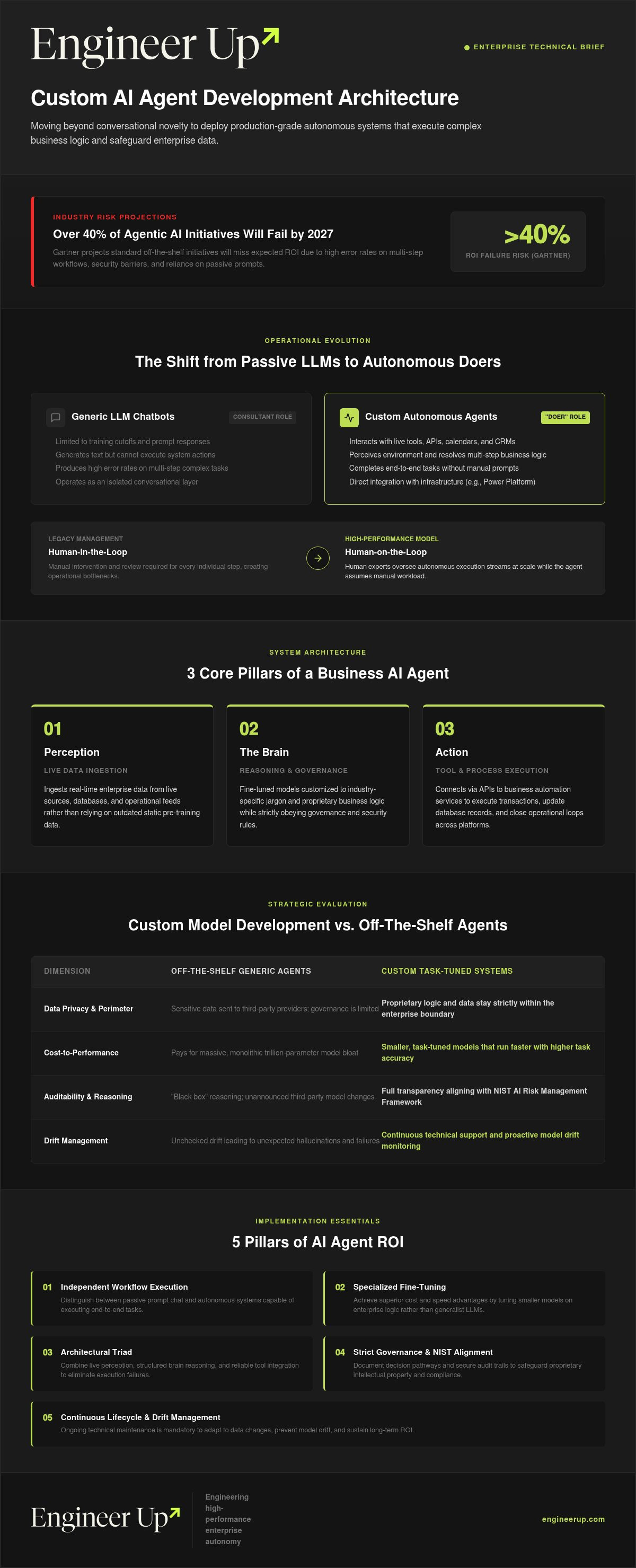
Gartner projects that over 40% of agentic AI initiatives will fail to meet their expected ROI by 2027. This failure often stems from treating AI as a conversational novelty rather than investing in rigorous custom ai agent development. You've likely seen these limitations firsthand. Generalist LLMs produce high error rates when faced with complex, multi-step tasks. Security concerns regarding proprietary data keep promising pilots trapped in permanent development cycles. It's frustrating to invest in technology that talks well but fails to execute.
Successful leaders demand more than just words from their technology. You don't need another passive chatbot; you need a digital workforce that handles the heavy lifting with precision. This article details how to build high-performance systems that move beyond simple prompts to execute complex business logic. We'll examine the technical architecture, state management, and security protocols required for true enterprise-grade autonomy. You'll learn how to deploy agents that reduce manual labor and deliver a measurable return on your AI investment.
Key Takeaways
• Distinguish between passive chat interfaces and autonomous agents capable of independent workflow execution.
• Evaluate the cost and performance advantages of specialized, fine-tuned models over generic enterprise solutions.
• Master the core architectural pillars of memory, planning, and tool integration to build stable autonomous systems.
• Implement a structured framework for custom ai agent development that focuses on high-ROI use cases and rigorous testing.
• Learn why continuous technical support is mandatory for managing model drift and ensuring consistent production output.
What is Custom AI Agent Development?
AI agents are autonomous systems designed to perceive their environment, reason through specific objectives, and take decisive action. Unlike standard software, they operate through an intelligent agent architecture that allows for independent problem-solving. While a simple chatbot responds to prompts with text, an execution-oriented agent interacts with external tools to complete a workflow. It doesn't just suggest a solution; it implements it. This distinction is critical for enterprise performance.
High-performance custom ai agent development focuses on building systems that handle ambiguity and execute complex business logic without constant manual intervention. This marks a significant shift from "human-in-the-loop," where every step requires approval, to "human-on-the-loop." In this new model, human experts oversee autonomous streams rather than managing individual tasks. You remain in control while the agent assumes the operational burden.
To better understand how these systems function in real-world scenarios, watch this helpful video:
The Evolution from LLMs to Agentic Systems
Static large language models are limited by their training data and lack of agency. They can draft an email but cannot check a calendar, book a meeting, or update a CRM autonomously. Agents bridge this gap by using APIs and databases as tools. In 2026, building these capabilities is a strategic necessity. Companies are moving away from monolithic models toward modular agentic systems. These systems deliver tangible ROI by automating end-to-end processes rather than just generating content. This transition represents the next phase of digital transformation where AI moves from a consultant role to a "doer" role.
Core Components of a Business AI Agent
A reliable business agent requires three fundamental pillars to function at an elite level. These components ensure the system remains stable and effective in a production environment.
Perception
The agent ingests enterprise data from live sources. This ensures its actions are based on current reality rather than outdated training sets.
Brain
This is the reasoning engine. Custom ai agent development often involves fine-tuning specialized models to understand industry-specific jargon and proprietary logic. This "brain" follows your specific governance rules and security protocols.
Action
The agent connects to business process automation services. It executes transactions, modifies records, and communicates across platforms to close the loop on tasks.
Strategic consulting ensures these components align with your specific business objectives. By integrating with existing ecosystems like the Microsoft Power Platform, agents move beyond the screen and interact directly with your infrastructure. This creates a seamless bridge between digital intelligence and physical business results, often requiring the mission-critical engineering expertise of AAC LTD | All About Control.
Custom AI Model Development vs. Off-the-Shelf Agents
Off-the-shelf agents promise rapid deployment but often deliver inconsistent results in production. They are built on generalist foundations designed to satisfy a broad user base. This creates a "black box" problem. You cannot audit the reasoning process or guarantee that the model won't drift into irrelevant outputs. Custom ai agent development solves this by prioritizing specialized performance over general knowledge. It gives you total control over the model weights, the training data, and the execution logic.
Proprietary model development offers distinct advantages for data privacy and security. When you build custom, your sensitive business logic remains within your controlled environment. Adhering to the NIST AI Risk Management Framework allows you to document every decision point in the agent's lifecycle. This transparency is mandatory for regulated industries where audit trails are as important as the output itself. Custom systems allow for a better cost-to-performance ratio because you aren't paying for the "bloat" of a trillion-parameter model when a smaller, task-tuned version would be faster and more accurate.
Security
Proprietary data remains within your enterprise perimeter.
Transparency
Eliminates hidden reasoning steps and opaque third-party updates.
Efficiency
Models are optimized to focus exclusively on specific business functions.
When Generalist Models Fail the Enterprise
Generalist models are prone to hallucinations because they prioritize "plausible" text over factual accuracy. In high-stakes departments like Finance or HR, a single error can trigger significant liability. These systems lack the context of your specific internal policies and historical data. Professional AI application development addresses this by grounding the agent in your proprietary knowledge base. If the system encounters a scenario outside its training, it recognizes its own limitations and fails safely instead of guessing.
The Value of Proprietary Data Fine-Tuning
Fine-tuning transforms a generic model into a specialized tool that understands your industry's nuances. It learns your specific product terminology, client hierarchies, and operational workflows. This precision reduces token costs because the model requires fewer instructions to produce the correct result. It also lowers latency. The agent doesn't waste processing power on irrelevant general knowledge. This approach builds structural integrity into your digital infrastructure, ensuring that your systems remain stable as your business grows. For leaders seeking a competitive edge, strategy consulting identifies the specific datasets that will yield the highest performance gains through custom tuning.
The Architecture of High-Performance AI Agents
High-performance architecture defines the difference between a pilot that stalls and a system that scales. Successful custom ai agent development relies on a three-pillar framework: memory, planning, and tool use. This structure allows action-oriented AI agents to function as reliable digital employees. They don't just process text; they manage state and execute multi-step operations across your enterprise ecosystem. This architectural rigor ensures that agents remain stable under the pressure of real-world business demands.
Retrieval-Augmented Generation (RAG) serves as the agent's real-time knowledge base. In an agentic context, RAG isn't just for answering questions. It provides the environmental context needed for autonomous decision-making. To ensure these systems remain aligned with business goals, you must integrate them into a broader ai automation strategy for enterprise. This ensures that every agentic action serves a high-ROI objective while maintaining strict adherence to corporate governance.
Complex tasks often require collaboration rather than a single monolithic solution. Multi-agent systems (MAS) involve specialized agents working together to solve intricate problems. One agent might handle data retrieval; another performs analysis while a third executes the final transaction. This modularity increases overall system stability. If one specialized agent fails, the system can isolate the error and attempt a recovery without collapsing the entire workflow.
Memory Systems: Short-term vs. Long-term
Agents require two types of memory to maintain operational integrity. Short-term memory tracks the immediate task context. Long-term memory, typically powered by vector databases, allows agents to recall historical data and proprietary knowledge over months or years. This persistence ensures data consistency across autonomous tasks. It prevents the agent from losing track of crucial business rules or client preferences during long enterprise workflows. Technical mastery in memory management is what allows an agent to learn from its environment over time.
Planning and Reasoning Frameworks
Elite agents use advanced frameworks like chain-of-thought or tree-of-thought reasoning to decompose complex goals. Instead of rushing to a conclusion, the system breaks a high-level objective into actionable steps. It evaluates potential paths and selects the most efficient route. Self-correction is built into this layer. If a tool call returns an error, the agent analyzes the failure, adjusts its plan, and tries an alternative approach. This resilience is the hallmark of professional custom ai agent development.
Implementing Custom AI Agents in Your Workflow
Successful implementation transforms a technical concept into a functional business asset. It begins with rigorous use-case discovery. You must prioritize workflows based on measurable ROI rather than novelty. Automating a broken process only accelerates failure. Once you identify high-value targets, the cycle moves into custom ai agent development. This stage involves fine-tuning models to your proprietary datasets and operational rules. It ensures the agent understands the specific nuances of your industry and internal logic.
Execution happens within the applications your team already uses. High-performance agents require seamless integration with power apps consulting services to create intuitive interfaces for human oversight. You aren't just building a script; you're constructing a digital workforce. This requires a structured deployment roadmap:
Discovery
Identify high-impact, repeatable tasks.
Development
Fine-tune models for precision and speed.
Integration
Connect agents to existing business systems.
Testing
Validate outputs against synthetic data and edge cases.
Monitoring
Track performance to prevent model drift.
Integrating with the Microsoft Ecosystem
The Microsoft ecosystem provides the most stable foundation for enterprise agents. You can leverage Power Automate to trigger complex sequences and Power Apps to provide a front-end for human-on-the-loop oversight. Azure environments offer the security and compliance standards necessary for large-scale deployment. To avoid the risks of "shadow IT" and fragmented systems, utilize enterprise ai agent consulting. This strategic approach ensures your autonomous systems remain centralized, secure, and aligned with your long-term infrastructure goals.
Security and Governance Guardrails
Autonomy requires strict boundaries. You must define the "action space" for every agent to prevent unauthorized transactions. Security isn't an afterthought; it's a core architectural component. Every decision an agent makes must generate a comprehensive audit log for future review. Protecting sensitive personally identifiable information (PII) is mandatory throughout the agentic lifecycle. These guardrails ensure that your systems remain compliant with evolving regulations while maintaining the speed of autonomous execution. High-performance systems prioritize safety to ensure long-term stability.
Build your autonomous workforce today by exploring our AI agent development services.
Lifecycle Management: Why Performance Requires Ongoing Support
Deployment is a milestone, not the finish line. High-performance autonomous systems degrade over time as the environment around them shifts. "Model drift" occurs when underlying data distributions change, or when external tool schemas and APIs evolve. Custom ai agent development must include a robust plan for continuous tuning to maintain accuracy. Without this, a system that performed at 98% accuracy on day one can quickly become a liability. Operational excellence requires a transition from the building phase to a state of permanent optimization and stability.
This is where ai managed services for business become a strategic necessity. Ongoing support isn't just about troubleshooting; it's about the labor-intensive process of refining prompts, retraining models, and managing technical debt. Specialists assume the burden of monitoring agentic behavior so your leadership can focus on primary goals. This differentiator turns a temporary pilot into a permanent enterprise solution that delivers consistent ROI. It ensures your digital workforce remains sharp as your business logic and market conditions evolve.
Proactive Tuning
Adjusting model weights to account for new proprietary data.
Schema Maintenance
Updating tool integrations to prevent breakage during API shifts.
Security Auditing
Ensuring autonomous actions remain within governance boundaries.
Monitoring Agent Performance and Accuracy
You can't manage what you don't measure. Key performance indicators (KPIs) for autonomous agents must include success rates, token efficiency, and execution latency. Automated feedback loops allow the system to learn from human-on-the-loop oversight, refining decision-making logic without a full rebuild. This process minimizes the 40% failure rate often seen in unmanaged agentic initiatives. AgentOps is the technical rigor required to maintain agentic uptime and reliability across the production lifecycle.
Scaling Custom AI Across the Enterprise
Scaling requires moving from a single-task agent to a coordinated multi-agent workforce. This expansion introduces complexity in state management and cost control. Efficient architecture prevents token cost blowouts during high-volume operations by routing tasks to the most cost-effective models. Partnering with a specialized custom ai app development firm provides the strategic consulting needed for long-term growth. They ensure your custom ai agent development efforts align with your existing Microsoft ecosystem. This commitment to technical mastery transforms isolated automations into a unified, high-performance digital infrastructure.
Deploying Your Autonomous Workforce
Deploying autonomous systems requires a strategic shift from conversational AI to execution-oriented architecture. You've seen how specialized models and rigorous state management outperform generic, off-the-shelf solutions every time. Success depends on grounding these systems in your proprietary data while maintaining strict security guardrails. High-performance custom ai agent development is the only reliable way to ensure your digital workforce delivers a measurable return on investment. It's about moving past the hype to build stable, structural foundations for your business.
Engineer Up provides the specialized Microsoft ecosystem expertise needed to bridge the gap between pilot programs and production-ready systems. We focus on boutique consulting that prioritizes tangible outcomes over decorative metrics. Our team assumes the technical burden of end-to-end strategy and provides the ongoing support required to manage model drift. We ensure your agents maintain peak efficiency long after the initial deployment. Stop managing passive tools and start deploying active systems that execute your workflows with precision.
Partner with Engineer Up for high-performance AI agent development and secure the long-term ROI of your AI investments today.
Frequently Asked Questions
What is the difference between an AI agent and a chatbot?
A chatbot primarily responds to prompts with text based on its training data. In contrast, an AI agent is an autonomous entity that perceives its environment and executes multi-step workflows. While a chatbot suggests an answer, an agent uses tools to complete the task. This transition from conversation to execution is the core of custom ai agent development. Agents manage state and handle errors independently to achieve a specific business objective.
How much does custom AI agent development cost for an enterprise?
The cost of custom ai agent development depends on system complexity, the depth of tool integration, and the level of model fine-tuning required. Enterprise-grade systems involve significant architectural planning and security guardrails that influence the total investment. Ongoing operational expenses, such as model inference and cloud hosting, also factor into the budget. Each project is unique, focusing on delivering a measurable return on investment through reduced manual labor and increased operational efficiency.
Can AI agents work with my existing legacy software?
AI agents can integrate with legacy systems through various technical layers. We utilize custom connectors, specialized APIs, or Robotic Process Automation (RPA) to bridge the gap between modern autonomous logic and older infrastructure. This approach allows the agent to read data from or write data to legacy databases without requiring a full system overhaul. Strategic consulting identifies the most stable integration points to ensure the agent performs reliably across your entire digital ecosystem.
How do you ensure custom AI agents are secure and compliant?
Security is maintained through strict boundary definitions and the implementation of deterministic guardrails. We leverage Azure's enterprise-grade security environments to protect sensitive data and ensure compliance with industry regulations. Every autonomous action generates a detailed audit log for transparent review. These systems prioritize PII protection and follow established risk management frameworks. By isolating the agent's action space, you prevent unauthorized transactions while maintaining the speed of autonomous execution.
How long does it take to deploy a functional custom AI agent?
Deployment timelines vary based on the project's scope and the complexity of the business logic. A focused pilot program targeting a single workflow can often reach a functional state in several weeks. A more comprehensive multi-agent system integrated across multiple departments typically requires several months of development and testing. This process includes discovery, model fine-tuning, and rigorous validation to ensure the system meets high-performance standards before full production release.
What industries benefit most from custom AI model development?
Industries with high-volume, data-intensive workflows realize the most significant benefits from autonomous systems. In precision-heavy fields like surveying and geomatics, agents can leverage services like WizNET to automate spatial data analysis and validation. Similarly, financial services, logistics, and human resources departments rely on agents to handle complex documentation and multi-step approvals. These sectors require the precision and reliability that specialized model development provides. Any organization managing large-scale operations within the Microsoft ecosystem can leverage these technologies to reduce manual errors and scale their output without increasing headcount.
You don't need an internal data science team to maintain high-performance autonomous systems. Partnering with a specialized firm for ongoing support and managed services assumes the technical burden of model monitoring and tuning. This allows your leadership to remain focused on primary business goals while experts handle model drift and technical updates. We provide the necessary technical mastery and strategic oversight to ensure your agents continue to deliver tangible outcomes over the long term.
How do custom AI agents integrate with Microsoft Power Platform?
Agents integrate with the Microsoft Power Platform by using Power Automate as their primary action layer. This allows the system to trigger sequences across hundreds of enterprise applications. Power Apps serves as the interface for human-on-the-loop oversight, providing a clear dashboard for monitoring autonomous decisions. This synergy ensures that agents operate within a familiar corporate environment. It leverages existing infrastructure to scale automation while maintaining centralized governance and elite performance standards.
WRITTEN BY
Get Your Team AI Ready
Let's hear your use case - we'll help you get on the path to AI readiness.

FILED UNDER
TOOLS IN THIS POST

