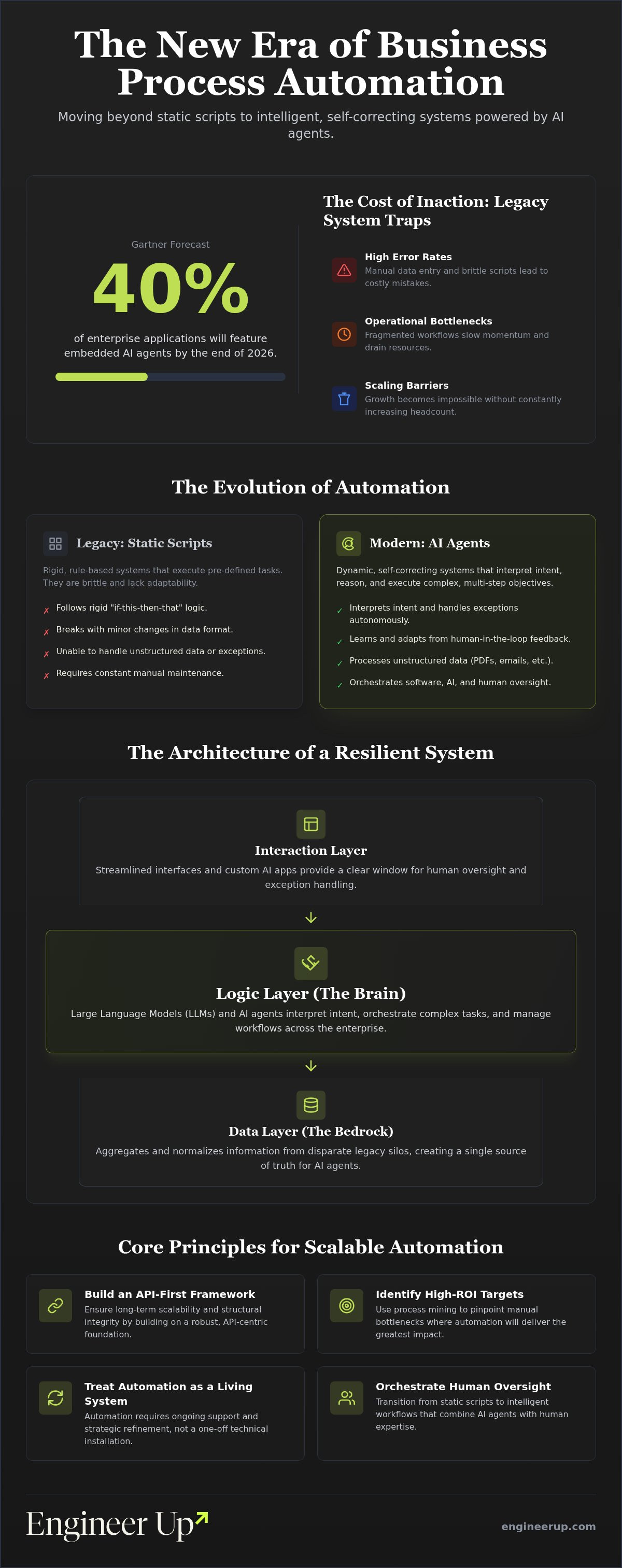
Gartner forecasts that 40% of enterprise applications will feature embedded AI agents by the end of 2026. Despite this massive technological shift, many organizations remain trapped in a cycle of manual data entry and fragmented legacy workflows. You've likely seen the impact firsthand. High error rates and operational bottlenecks make it impossible to scale without constantly increasing your headcount. It's a structural weakness that drains resources and slows momentum. Integrating professional business process automation services is no longer a luxury for the future. It's a requirement for current survival.
We understand the burden of technical complexity. You need systems that perform without constant oversight. This guide provides a direct roadmap to replace brittle manual processes with high-performance automated systems. You'll learn how to deploy intelligent AI agents that reason and execute within a governed enterprise framework. We'll cover the essential regulatory shifts of August 2026, including the EU AI Act transparency duties and new US federal oversight mechanisms. By the end, you'll have the strategy needed to eliminate overhead and build a scalable, AI-driven foundation for your business operations.
Key Takeaways
• Transition from static, rule-based scripts to intelligent, self-correcting workflows that orchestrate AI agents and human oversight.
• Utilize professional business process automation services to build an API-first framework that ensures long-term scalability and structural integrity.
• Implement a three-tier architecture to integrate Large Language Models directly into your existing data and interaction layers.
• Identify high-ROI automation targets through process mining to eliminate manual bottlenecks without increasing your total headcount.
• Treat automation as a living system that requires ongoing support and strategic refinement rather than a one-off technical installation.
Defining Business Process Automation Services in the AI Era
Business process automation traditionally focused on digitizing repetitive tasks to increase organizational efficiency. In 2026, that definition is obsolete. Modern business process automation services now encompass the high-performance orchestration of software, autonomous AI agents, and human oversight. We've moved beyond simple triggers. Today's enterprises require intelligent, self-correcting workflows that assume the burden of complex data management. This shift represents a transition from static scripts to dynamic, outcome-oriented systems.
Professional services differ from stand-alone tools in their scope and reliability. A tool provides a capability; a service provides a result. Professional automation involves strategy consulting, custom development, and ongoing support to ensure the system evolves with your business. It's a specialized force that builds stability into your digital infrastructure. You aren't just buying software. You're investing in a governed framework designed to scale without breaking under the weight of manual errors.
The Evolution of Automation: From Scripts to Agents
Legacy systems relied on rigid logic. If a specific event occurred, a pre-defined script executed a single task. These systems were brittle. They broke the moment a data format changed or a minor variable shifted. Modern BPA utilizes AI-driven agents capable of reasoning. These agents don't just follow instructions; they interpret intent and handle exceptions autonomously. Agentic BPA is the new enterprise standard that replaces static triggers with autonomous systems capable of planning and executing multi-step business objectives.
Why High-Performance Automation is a Strategic Asset
Think of automation as the structural integrity of a skyscraper. Without a reinforced digital foundation, your operations cannot support the weight of rapid growth. High-performance business process automation services act as this foundation. They reduce the heavy lifting for your specialized workforce. By stripping away manual data entry and fragmented legacy workflows, you lower the cognitive load on your team. This allows your human talent to focus on high-value strategic labor rather than administrative maintenance.
Speed is the primary outcome. Scaling no longer requires a proportional increase in headcount. You aren't just cutting costs. You're creating value by accelerating every phase of your business cycle. This transformation turns your operational backend from a cost center into a competitive engine. Precision in these workflows ensures that as you grow, your error rates remain at zero, maintaining the professional standards your clients expect.
The Architecture of Modern Enterprise Workflow Automation
Modern enterprise automation is a structural discipline. It requires a resilient three-tier architecture to move beyond the limitations of legacy systems. Professional business process automation services construct this foundation through a Data Layer, a Logic Layer, and an Interaction Layer. The Data Layer serves as the bedrock, aggregating information from disparate legacy silos. The Logic Layer acts as the brain, where Large Language Models (LLMs) interpret intent and orchestrate complex tasks. Finally, the Interaction Layer utilizes custom AI apps to provide a streamlined interface for human oversight. Understanding how BPA, RPA and BPM interrelate is essential for designing a stack that remains stable under heavy operational loads.
Building this architecture is only the first step. High-performance systems require Ongoing Support to maintain peak efficiency. As your data environment shifts, your automation must adapt. We assume the burden of this technical maintenance so your leadership can focus on strategic growth. If you are ready to modernize your stack, our strategy consulting can help define your technical roadmap.
Integrating Custom AI Agents into Core Workflows
AI agents are the workforce of the modern enterprise. Unlike traditional scripts, these agents handle unstructured data like PDFs, emails, and voice transcripts with high precision. They don't just execute; they reason. We build feedback loops into these workflows. When an agent encounters a complex exception, it flags a human for review. The system then captures that resolution to refine its future performance. Secure API integration ensures these agents communicate seamlessly with your existing legacy infrastructure, bridging the gap between old data and new intelligence.
The Power Platform Advantage: Governance at Scale
Scaling automation without governance is a liability. We utilize the Microsoft ecosystem to provide elite security and cross-application connectivity. Power Automate serves as the connective tissue between your enterprise applications. This approach ensures that every automated process adheres to your organization's compliance standards. For organizations looking to build high-performance interfaces, our Power Apps Consulting Services provide the specialized expertise needed to deploy custom AI apps at scale. This focus on governance protects your structural integrity while enabling rapid operational expansion.
BPA vs. RPA: A Strategic Selection Framework
Enterprises often mistake Robotic Process Automation (RPA) for a complete automation strategy. It isn't. RPA is a tactical tool designed to mimic human interactions with a user interface. In contrast, business process automation services focus on a holistic, API-first approach that restructures how work flows through an organization. While RPA acts as a temporary patch for legacy systems, BPA builds the long-term structural integrity required for a modern digital foundation. Choosing the wrong path creates technical debt that will eventually stall your operations.
A hybrid approach is often the most efficient route. You use bots to handle rigid, legacy UI tasks and intelligent agents to manage complex, data-driven decisions. This ensures you aren't over-engineering simple tasks or under-powering critical workflows. The goal is to assume the burden of technical complexity at the architecture level so your team can focus on output. Gartner reports that 90% of large enterprises now view this type of hyperautomation as a key strategic priority for 2026. Success depends on knowing exactly where to apply each method.
When to Deploy RPA for Legacy Systems
RPA is the correct choice when you're forced to work with systems that lack modern API access. It solves the "swivel chair" problem by moving data between disconnected screens without manual intervention. It's effective for high-volume, low-variance tasks where the rules never change. However, RPA is brittle. If a software vendor updates a button's location or changes a field label, the bot breaks. Relying on RPA for complex workflows leads to high maintenance costs and frequent operational downtime. It is a tactical fix, not a scalable solution.
Why BPA is the Foundation for Digital Transformation
BPA is built for the future. It utilizes API-first design principles to connect systems at the data layer rather than the interface layer. This makes the automation resilient to software updates and capable of handling massive transaction volumes. High-performance business process automation services prioritize this stability. When evaluating which process to automate first, use this checklist:
API Availability
Does the target system allow direct data integration?
Decision Complexity
Does the task require reasoning or just data entry?
Transaction Volume
Will the workflow scale to thousands of daily operations?
Process Stability
Is the workflow well-defined or subject to frequent changes?
If the answer to these questions points toward complexity and high volume, BPA is the mandatory choice. It eliminates the manual bottlenecks that prevent scaling. By shifting to an API-driven model, you ensure that your automation remains a high-performance asset rather than a maintenance liability.
Executing a Scalable Automation Roadmap
Execution is not a one-off event. It is a methodical four-phase progression that ensures structural integrity at every level of the organization. Professional business process automation services provide the framework to move from a pilot project to enterprise-wide adoption without losing momentum. This roadmap assumes the burden of technical complexity so your leadership can focus on results rather than maintenance. Success requires a disciplined approach to identifying, designing, and governing your automated systems.
Phase 1: Process Mining and Identification.
We use data-driven analysis to find high-ROI targets. We don't rely on guesswork. We identify the bottlenecks where manual labor is most expensive.
Phase 2: Architecture Design.
We establish security and performance standards. This phase ensures your automation stack integrates seamlessly with your existing Microsoft ecosystem.
Phase 3: Development and AI Agent Training.
This is the build phase. We develop custom AI apps and train intelligent agents to handle specific business reasoning.
Phase 4: Governance and Scaling.
We implement controls to prevent the rise of Shadow IT. This phase ensures that as you scale, your operations remain secure and compliant with current regulations.
If you're ready to begin your transformation, book a strategy consulting session to define your roadmap.
Process Mapping: Identifying Automation Candidates
Effective automation begins with clearing the digital rubble. You must identify high-volume, low-variance tasks that offer immediate ROI. Automating a broken or inefficient process only accelerates failure. We look for repeatable workflows where manual intervention adds no strategic value. Automation Readiness is the objective verification that a process is mature enough for digital conversion. By focusing on these candidates first, you build the internal buy-in needed for more complex agentic deployments.
Governance: Scaling Without Shadow IT Risks
Scaling automation without a central authority leads to fragmented systems and security vulnerabilities. We recommend establishing a Center of Excellence (CoE) to manage permissions and data access. This is especially critical in low-code environments where "Shadow IT" can quickly compromise your structural integrity. Proper governance ensures that every automated workflow adheres to enterprise-grade security protocols. For a deeper look at managing these complex systems, explore our guide on Enterprise AI Agent Consulting. This disciplined approach protects your data while allowing for rapid, decentralized innovation.
The Engineer Up Approach: Precision Automation Services
Engineer Up delivers precision. We don't sell generic software. Our business process automation services focus on high-performance AI Agents and custom AI-Apps. We assume the burden of technical complexity. This specialized force allows your leadership to remain focused on primary objectives. We value substance over superficiality. Our goal is tangible outcomes, not self-congratulation.
Automation is a living system. It requires Ongoing Support to maintain peak performance as your data landscape shifts. We don't view development as a one-off task. We view it as the construction of your digital foundation. Structural integrity depends on continuous refinement. We provide the technical mastery needed to ensure your systems never break under the weight of scaling operations.
Bespoke AI Development for High-Performance Teams
Off-the-shelf tools lack the nuance required for elite enterprise environments. They can't handle your specific business logic. We build tools from the ground up to reason within your unique framework. This commitment to Custom AI App Development ensures elite reliability. We replace manual labor with digital precision. Your team moves from data entry to strategic labor. This shift reduces cognitive load and accelerates value creation.
Our Strategy Consulting ensures your technology aligns with your long-term goals. We don't just build; we plan. We identify the high-impact targets that drive the most ROI. This results-oriented approach eliminates manual bottlenecks. It transforms your operational backend into a high-performance engine. You gain the speed needed to outpace the competition without increasing your headcount.
Your Next Steps Toward Operational Excellence
Transitioning from manual workflows to autonomous systems starts with a single pilot. Identify one high-volume process. Clear the digital rubble. Deploy an intelligent agent to assume the burden of that task. Once you verify the ROI, we scale the solution across your entire enterprise. This methodical progression ensures stability and performance. It's time to stop talking about automation and start building it. Contact us today for a professional automation assessment. Let's build the systems that drive your growth.
Securing Your Operational Foundation for 2026
The transition to autonomous enterprise operations is no longer optional. You've seen the roadmap to replace fragmented legacy workflows with high-performance AI agents. By prioritizing an API-first architecture and establishing rigorous governance, you eliminate the manual bottlenecks that stall growth. High-performance business process automation services turn operational complexity into a strategic engine. This structural shift allows your specialized workforce to focus on high-value labor while digital systems assume the technical burden.
Stability requires more than just a software installation. It demands a specialized force that understands the Microsoft Power Platform and the nuances of custom AI agent development. We provide boutique consulting focused on elite enterprise outcomes. Our commitment to end-to-end development and ongoing support ensures your automation remains a high-performance asset. Consult with Engineer Up for High-Performance Automation Services to build a scalable foundation for your business. It's time to lead with precision.
Frequently Asked Questions
What is the difference between BPA and RPA?
RPA handles repetitive tasks by mimicking human clicks on a screen. It acts as a digital patch for legacy systems lacking modern interfaces. Business process automation services take a broader approach by restructuring entire workflows through API-first integration. While RPA is brittle and breaks with UI changes, BPA builds a resilient digital foundation. This holistic strategy ensures your operations remain stable even as individual software applications evolve.
How do business process automation services improve ROI?
Automation increases ROI by stripping away the manual labor that drives up operational overhead. You reduce error rates to near zero, eliminating the cost of rework and manual data entry. High-performance systems accelerate your business cycle, allowing you to process higher volumes without increasing headcount. By assuming the burden of repetitive technical tasks, these services free your specialized workforce to focus on high-value strategic initiatives that directly generate revenue.
Can AI agents be integrated into my existing legacy systems?
Yes, we integrate intelligent agents into legacy environments using secure API connectors and custom middleware. These agents don't require you to rip and replace your current infrastructure. They sit on top of your existing data layers, interpreting unstructured information and executing tasks across disconnected platforms. This approach preserves your previous investments while adding modern reasoning capabilities. We build the structural integrity needed to bridge the gap between old data silos and new AI logic.
How do I prevent shadow IT when scaling automation?
Preventing shadow IT requires a centralized governance framework, often called a Center of Excellence (CoE). You must establish clear permissions, data loss prevention (DLP) policies, and standardized development environments. This ensures that decentralized teams can build automations within a secure, IT-sanctioned sandbox. By providing a governed platform like Microsoft Power Platform, you give employees the tools they need while maintaining full visibility and control over enterprise data security.
What industries benefit most from business process automation services?
Any industry with high-volume, data-intensive workflows sees significant gains. Finance and insurance benefit from automated claims processing and compliance reporting. Human resources departments utilize automation for streamlined onboarding and payroll management. Logistics companies use these systems to coordinate complex supply chain data. High-performance business process automation services are essential for any enterprise where manual bottlenecks prevent rapid scaling or where error-prone data entry threatens operational stability.
Is ongoing support necessary for automated workflows?
Ongoing support is mandatory because automation is a living system. Software updates, API changes, and shifting data formats can disrupt even the most robust workflows. Professional maintenance ensures your systems continue to perform at peak efficiency without downtime. We provide technical mastery to refine your AI agents and troubleshoot logic exceptions as they arise. This persistent oversight protects your digital foundation and ensures your automation evolves alongside your business objectives.
What is the first step in an enterprise automation roadmap?
The first step is professional strategy consulting to identify high-ROI targets. You must clear the digital rubble by mapping your current processes and identifying which tasks are mature enough for automation. This "Automation Readiness" assessment prevents you from automating an inefficient or broken workflow. We focus on finding the manual bottlenecks where labor costs are highest and performance is lowest. Starting with a high-impact pilot project builds the momentum needed for enterprise-wide adoption.
How secure is AI-driven process automation for finance and HR?
AI-driven automation is highly secure when built within a governed enterprise ecosystem like Microsoft Power Platform. We implement multi-layered security protocols, including end-to-end encryption and role-based access controls. These systems comply with strict regulatory standards by building transparency and audit logs directly into the workflow. You maintain full ownership of your data while utilizing intelligent agents to handle sensitive information with a level of precision that manual processes cannot match.
WRITTEN BY
Get Your Team AI Ready
Let's hear your use case - we'll help you get on the path to AI readiness.

FILED UNDER
TOOLS IN THIS POST

