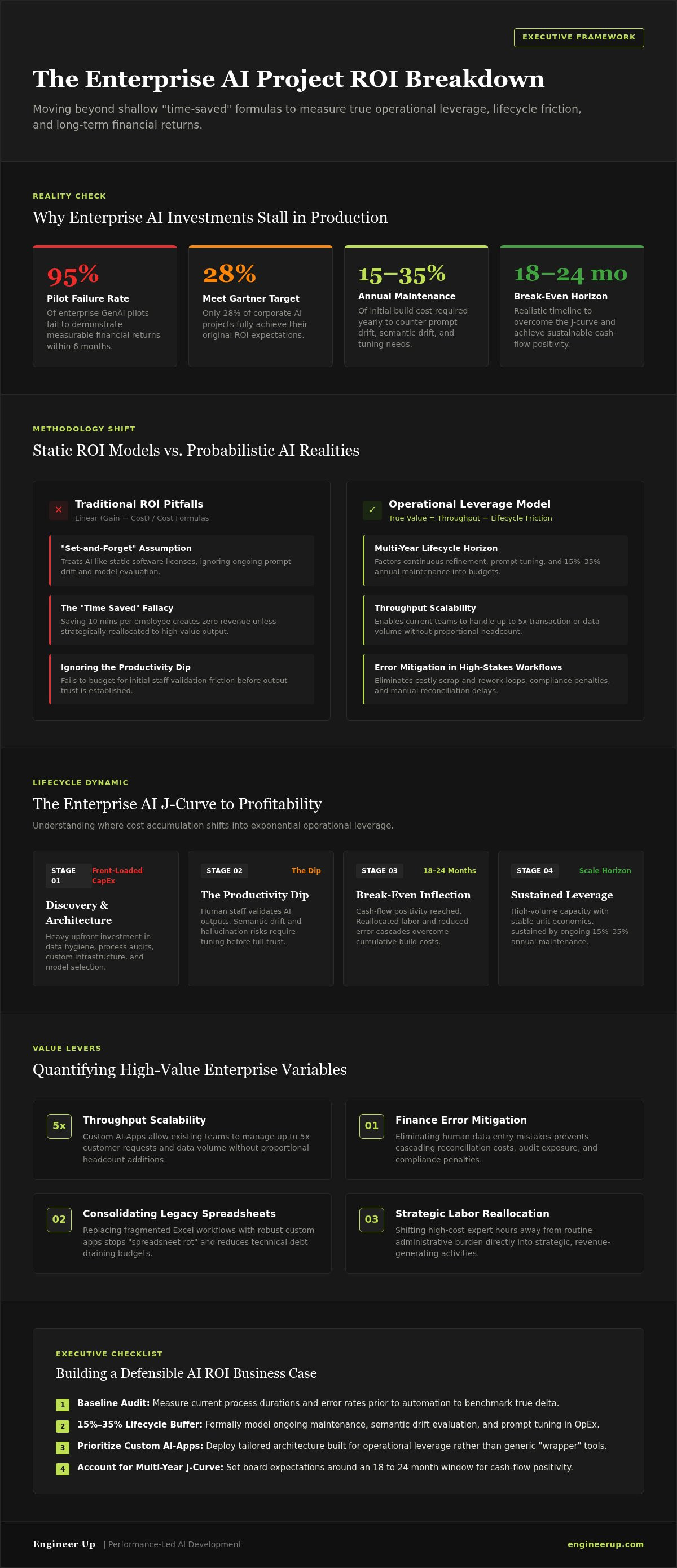
Ninety-five percent of enterprise generative AI pilots fail to show measurable financial returns within six months of launch. This stark reality exposes the danger of relying on vague vendor promises instead of a rigorous ai project roi calculator. Most leaders overlook the 15% to 35% annual maintenance cost required to sustain model performance over time. Without a framework to track the delta between operational throughput and lifecycle friction, your automation investment will likely stall in production. You deserve a clear path to profitability that moves beyond theoretical hours saved.
You likely face the challenge of defending complex budgets while struggling to quantify soft benefits like employee satisfaction. It's a high-stakes environment where Gartner reports only 28% of projects fully meet ROI expectations. This article provides a repeatable framework to master the variables of AI profitability and calculate the hard-dollar value of your investments. You'll gain the confidence to defend your budget with data-backed projections. We will examine the specific variables of enterprise operational leverage and identify exactly when your project reaches its break-even point.
Key Takeaways
• Move beyond shallow formulas to measure the true delta between operational throughput and lifecycle friction.
• Deploy a specialized ai project roi calculator that factors in the 15% to 35% annual maintenance cost required for sustained model performance.
• Quantify high-value variables such as error mitigation in finance workflows and the strategic reallocation of expert labor hours.
• Execute a baseline audit of current process durations to establish a clear benchmark for automation success.
• Prioritize custom AI-Apps over generic tools to ensure your architecture is built for maximum operational leverage.
Why Traditional ROI Models Fail for Custom AI Projects
Standard ROI formulas fail because they ignore the non-deterministic nature of AI. Calculating (Gain - Cost) / Cost works for a static server or a simple software license. It breaks when applied to systems that suffer from prompt drift, semantic drift, and hallucination risks. You need an ai project roi calculator that accounts for these probabilistic variables. Traditional models treat AI like a "set and forget" asset. In reality, enterprise AI requires a multi-year horizon to account for the iterative scaling and refinement necessary for success.
The "Time Saved" trap is another common pitfall. Saving ten minutes per employee only generates profit if that time is reallocated to revenue-generating activities. Without strategic intent, those minutes simply vanish into the workday. Real impact comes from increasing your operating leverage. This financial mechanic allows your existing team to handle significantly higher volumes without increasing headcount. You must measure the delta between operational throughput and lifecycle friction to find the true value.
To better understand how these efficiencies translate into enterprise value, watch this breakdown of driving ROI with generative AI:
The Flaw of Linear Cost Projections
AI costs are heavily front-loaded. You pay for discovery, data hygiene, and custom architecture long before the first output. Traditional models miss the "Productivity Dip" where staff must validate AI outputs before trust is established. A realistic timeline for enterprise AI often shows a J-curve. Research indicates it takes 18 to 24 months to reach cash-flow positivity. Ignoring the annual maintenance benchmark of 15% to 35% of the original build cost is a recipe for budget failure. Your financial model must account for model evaluation and prompt tuning to maintain long-term viability.
Direct vs. Indirect Value Drivers
Direct savings are easy to identify. You replace expensive third-party software or reduce contractor spend. Indirect drivers are more powerful but require precise tracking. Custom AI Agents create value by assuming the burden of complex technical tasks. This accelerates decision cycles and reduces the cost of human error in high-stakes environments like finance. These agents don't just save time. They provide a structural foundation for scaling operations. By integrating these variables into your ai project roi calculator, you move from vague promises to a defensible business case.
Identifying the Variables of AI Operational Leverage
Operational leverage is the engine of enterprise growth. It represents the ability to increase output without a corresponding increase in input costs. An effective ai project roi calculator must look beyond simple time-tracking to identify where these levers exist. Most organizations start with labor arbitrage. They replace high-frequency, low-value manual tasks with Automations. This is only the foundation. True leverage comes from increasing throughput scalability. Custom AI-Apps allow your existing team to handle five times the volume of data or customer requests without additional hiring. This shift changes the fundamental unit economics of your business.
Error mitigation provides a massive, often ignored financial return. In finance and data entry workflows, a single human error can trigger a cascade of reconciliation costs and compliance penalties. Automating these processes eliminates the "scrap and rework" cycle that plagues manual entry. This aligns with the Brookings Institution's analysis on AI productivity, which suggests that the greatest gains come from enhancing human capability and precision. Infrastructure efficiency also drives value. Consolidating fragmented legacy Excel processes into streamlined Power Apps reduces the technical debt and "spreadsheet rot" that drains annual budgets. By integrating these metrics into your ai project roi calculator, you build a defensible case for budget approval.
Hard ROI: The Tangible Financial Metrics
Hard ROI focuses on the bottom line. You must measure the reduction in Full-Time Equivalent (FTE) hours required for specific operations. If an AI Agent handles 80% of initial customer inquiries, those hours are directly reclaimed for high-value work. You also see a decrease in third-party software licensing costs. Many enterprises pay for redundant, niche tools that a single custom AI-App can replace. Eliminating legacy system maintenance fees provides immediate cash-flow relief. These are the "hard-dollar" values that justify the initial development spend and provide a clear break-even point.
Soft ROI: The Strategic Value Multipliers
Soft ROI metrics act as strategic multipliers even if they are harder to track. Improved employee retention is a primary example. By removing "the work they hate," you reduce the high cost of turnover and employee burnout. Customer experience also improves. AI Agents provide instant response times, which correlates directly with increased lifetime customer value and brand trust. Better governance is another critical variable. Moving tasks into a managed AI environment eliminates shadow IT and reduces the risk of data leaks. If you need to identify these variables within your own workflow, strategy consulting can provide the necessary baseline audit to protect your investment.
The AI Project ROI Framework: A Step-by-Step Template
A repeatable framework removes the guesswork from budget defense. Your ai project roi calculator must follow a logical progression from current state to future state. Start with Step 1: the Baseline Audit. You cannot measure gain without knowing your starting point. Record the exact duration of manual processes and track current error rates across your target workflows. Step 2 involves Implementation Cost. This includes Strategy Consulting and the build phase for custom AI-Apps. According to Harvard Business School Online's analysis of AI implementation costs and ROI, failing to factor in integration and human capital costs often leads to project abandonment. These upfront investments establish the structural integrity of your automation.
Step 3 is the Operational Delta. This is the projected efficiency gain once the system is live. You calculate this by subtracting the new automated cycle time from your original baseline. Step 4 covers Lifecycle Cost. This is where many models fail. You must include Ongoing Support and API consumption fees. Research shows annual maintenance typically equals 15% to 35% of the original build cost. Overlooking these recurring expenses will skew your results and lead to production cost overruns that erode your margins. Accurate forecasting requires accounting for every token and support hour.
The Core Calculation Formula
To find your total ROI, use this specific template: Total ROI = [(Annual Savings + Revenue Lift) - (Development + Annual Support)] / (Development + Annual Support). Revenue Lift represents your ability to capture more market share through increased operational speed. It isn't just about saving money; it's about making money faster. For example, reducing an RFP turnaround time from days to minutes allows you to bid on more opportunities. AI ROI is the financial expression of operational leverage, and for those scaling their business value, it can be beneficial to explore Success-based Equity and Carry Fees to align advisory incentives with these realized gains.
A successful enterprise AI project typically achieves a payback period between 6 and 18 months. While off-the-shelf SaaS solutions offer lower upfront costs, they often lack the deep integration needed for high-impact leverage. Investing in custom ai app development for business accelerates the break-even point by targeting your specific bottlenecks. This tailored approach ensures the system scales with your volume instead of hitting the functional ceiling of a generic tool. Proper architecture protects your margins as you scale. This specialization delivers a more robust return than generic, one-size-fits-all software.
Accounting for the Lifecycle: Maintenance and Support Costs
AI systems are living infrastructure. They require active management to prevent performance decay over time. Your ai project roi calculator must include these operational expenses (OpEx) to remain accurate over a multi-year horizon. Without a dedicated budget for model refinement and data pipeline maintenance, the initial efficiency gains will evaporate as your data environment shifts. Professional AI managed services for business act as an ROI insurance policy. They ensure the system continues to deliver the high-impact outcomes identified during the strategy phase. Budgeting for ongoing Strategy Consulting is equally critical. It allows your leadership to identify new automation opportunities as your internal processes evolve and mature.
The Hidden Friction of Model Drift
Model drift is the silent killer of AI profitability. As real-world data patterns change, the model’s predictive accuracy declines. For a customer-facing AI Agent, this manifests as higher hallucination rates and lower resolution success. This technical debt accumulates rapidly in unmanaged applications. It eventually turns a high-performing asset into a financial liability. Maintaining high-performance AI over a 3-5 year cycle requires perpetual evaluation loops. You must monitor for semantic shifts and update prompt logic to protect your financial returns. A stagnant model is a failing investment that drains resources without providing leverage.
Support as a Value Driver, Not a Cost Center
Support is often mislabeled as a cost center. In the enterprise AI space, proactive technical support for AI apps is a primary value driver. It prevents system downtime and ensures continuous optimization of the underlying architecture. This proactive stance prevents ROI erosion caused by stagnant workflows or broken API integrations. Governance also plays a critical role in this phase. Centralized support prevents the sprawl of shadow IT. This reduces the risk of data leaks and eliminates redundant licensing fees for unmanaged tools. High-performance standards require a dedicated force to assume the burden of these technical challenges so you can focus on core objectives.
Protect your automation investment by securing ongoing support for your custom AI ecosystem.
Maximizing ROI with Engineer Up: Performance-Led AI Development
Generalist agencies often deliver broad, shallow solutions. These lack the precision required to move the needle on enterprise P&L. Engineer Up operates as a specialized force focused on tangible outcomes. We design architecture for maximum operational leverage. Every variable in our ai project roi calculator is mapped to a specific technical capability. This ensures that development effort translates directly into throughput gains. We prioritize enterprise ai agent consulting to solve complex, high-value problems that generic tools cannot touch.
Many organizations remain trapped in legacy Excel processes. These fragmented workflows create massive technical debt and hidden labor costs. Our power apps consulting services transition these manual tasks into high-impact digital systems. This consolidation reduces licensing fees and eliminates data silos. We build for the Microsoft ecosystem to leverage your existing infrastructure investments. This strategy lowers the barrier to entry and shortens the path to profitability. We assume the burden of complex technical challenges so your leadership can focus on primary objectives.
Bespoke Solutions vs. Generic Tools
Standard SaaS platforms suffer from feature bloat. You pay for capabilities your team will never use. Custom AI-Apps eliminate this waste by providing 100% utility. We tailor every automation to your specific enterprise workflows. This precision ensures that the system assumes the full burden of technical challenges. It allows your staff to remain focused on primary business goals. A bespoke approach protects your margins by removing the friction of unnecessary software overhead. You gain a stable, high-performance asset that is built to scale with your volume.
Your Roadmap to AI Profitability
Success requires a methodical progression. We begin with a high-impact pilot to prove the ai project roi calculator projections quickly. This initial win builds the confidence needed for enterprise-wide adoption. From there, we scale through a structured AI automation strategy for enterprise. This framework ensures that each subsequent investment builds upon the last. It creates a compounded return that generic tools simply cannot match. Our process is transparent and results-oriented. Contact Engineer Up to build your custom AI project ROI roadmap and secure your competitive advantage.
Secure Your Operational Advantage
Success in enterprise automation requires moving past vague productivity claims. You must treat AI as a structural asset that demands rigorous financial tracking and active maintenance. A precise ai project roi calculator allows you to defend your budget by quantifying the delta between throughput gains and lifecycle friction. We've established that high-performance outcomes depend on bespoke architecture and the strategic displacement of high-frequency manual tasks. Ignoring the 15% to 35% annual maintenance benchmark isn't an option for serious leadership.
Engineer Up assumes the burden of these complex technical challenges. As specialists in Microsoft Power Platform and AI Agents, we build performance-focused development architecture designed for stability. Our comprehensive ongoing support and managed services ensure your investment remains profitable over a multi-year horizon. You have the framework; now you need the execution. Request an AI Performance Audit to Calculate Your Potential ROI and move your project from pilot to production. Your roadmap to scalable profitability starts with data-backed decisions.
Frequently Asked Questions
How long does it typically take to see a positive ROI on an AI project?
Most enterprise AI projects reach cash-flow positivity within 18 to 24 months. While high-impact pilots can show results in as little as 6 months, the initial costs of data hygiene and custom architecture create a front-loaded investment. This extended timeline accounts for the "Productivity Dip" where staff must validate outputs before full adoption. Success depends on maintaining a multi-year horizon rather than expecting immediate returns from the first month of deployment.
What are the biggest hidden costs in an AI project budget?
Ongoing maintenance and model refinement represent the most significant hidden expenses. Research indicates that annual support costs typically run between 15% and 35% of the original build price. Other overlooked variables include LLM token consumption, vector database hosting, and the "adoption discount" caused by workforce resistance. A comprehensive ai project roi calculator must factor in these recurring operational expenses to prevent production cost overruns that erode your projected margins over time.
Can I calculate ROI for AI projects that don't directly reduce headcount?
You should measure ROI through operational throughput and error mitigation rather than just headcount reduction. AI creates value by allowing your existing team to handle significantly higher volumes without increasing costs. This increase in operating leverage is often more profitable than layoffs. Focus on metrics like ticket resolution latency, revenue capacity per employee, and the elimination of "scrap and rework" cycles in high-stakes environments like finance or data entry.
How does model drift affect the long-term ROI of an AI application?
Model drift causes a steady decline in accuracy as real-world data patterns evolve away from the original training set. This degradation forces human staff to spend more time on manual validation, which directly increases operational costs and lowers the net return. Without active management and perpetual evaluation loops, a high-performing asset eventually becomes a financial liability. Sustained ROI requires a commitment to ongoing support to tune prompts and update model logic.
Is it better to build custom AI-Apps or buy off-the-shelf software for maximum ROI?
Custom AI-Apps typically deliver a higher return for enterprise-specific workflows because they eliminate feature bloat and technical friction. While off-the-shelf software has lower upfront costs, it often lacks the deep integration required for maximum operational leverage. Bespoke solutions are tailored to your specific business logic and existing Microsoft infrastructure. This precision ensures 100% utility, which accelerates the break-even point and allows the system to scale seamlessly with your volume.
How do I quantify the value of 'improved decision making' in my ROI calculation?
Quantify improved decision-making by tracking cycle time acceleration and the reduction of high-cost errors. Measure the delta between your baseline manual process and the new AI-augmented workflow. For example, if faster RFP turnarounds allow you to bid on 20% more deals, that increased revenue capacity is a direct financial gain. You must move away from vague "soft" benefits and focus on the hard-dollar impact of speed and precision on your bottom line.
What is the difference between ROI and TCO (Total Cost of Ownership) in AI?
ROI measures the net gain relative to your investment, while TCO accounts for the cumulative cost of building, operating, and maintaining the system over its entire lifecycle. In AI, TCO often lands at two to three times the initial development spend due to API tokens, infrastructure hosting (which can be optimized via Backplane), and ongoing support. Your ai project roi calculator is only accurate if it uses the full TCO as the denominator to reflect the true cost of sustained performance.
You must include employee training as a core component of your initial implementation costs. AI systems only generate value if your workforce adopts them effectively. Training reduces the friction of change management and shortens the "Productivity Dip" that occurs during initial deployment. Failing to account for this human capital investment leads to optimistic but unrealistic payback projections. Comprehensive budgeting ensures that your team has the skills to leverage the new architecture for maximum output.
WRITTEN BY
Get Your Team AI Ready
Let's hear your use case - we'll help you get on the path to AI readiness.

FILED UNDER
TOOLS IN THIS POST

