Deploying an autonomous agent without a rigorous governance framework isn't innovation. It is professional negligence. By 2026, the gap between high-performing enterprises and those drowning in technical debt will be defined by their approach to ai agent lifecycle management. You likely feel the pressure to move fast. You want the efficiency gains promised by autonomous workflows. However, you also recognize the mounting risks of agent drift and over-privileged non-human identities. These aren't just technical bugs. They are structural liabilities that threaten your operational integrity.
We understand the difficulty of tracking tangible ROI while managing a digital workforce that evolves in real time. This guide provides the definitive framework to master the end-to-end management of autonomous agents. You will learn how to secure non-human identities, eliminate hallucinations, and ensure every deployment delivers measurable business value. We break down the transition from legacy manual processes to a streamlined agent ecosystem. This is the blueprint for reducing technical debt through continuous performance optimization and elite supervision standards.
Key Takeaways
• Understand why ai agent lifecycle management is distinct from traditional SDLC by focusing on autonomous behavior and identity governance.
• Master the five stages of agent deployment, from defining authority boundaries to continuous performance optimization.
• Protect enterprise assets by implementing a centralized agent registry and enforcing "Least Privilege" access for all non-human identities.
• Identify the critical differences between MLOps and ALM to ensure your governance model addresses the adaptive nature of autonomous systems.
• Transition from experimental pilots to high-performance enterprise workflows through strategic integration and ongoing technical support.
What is AI Agent Lifecycle Management (ALM)?
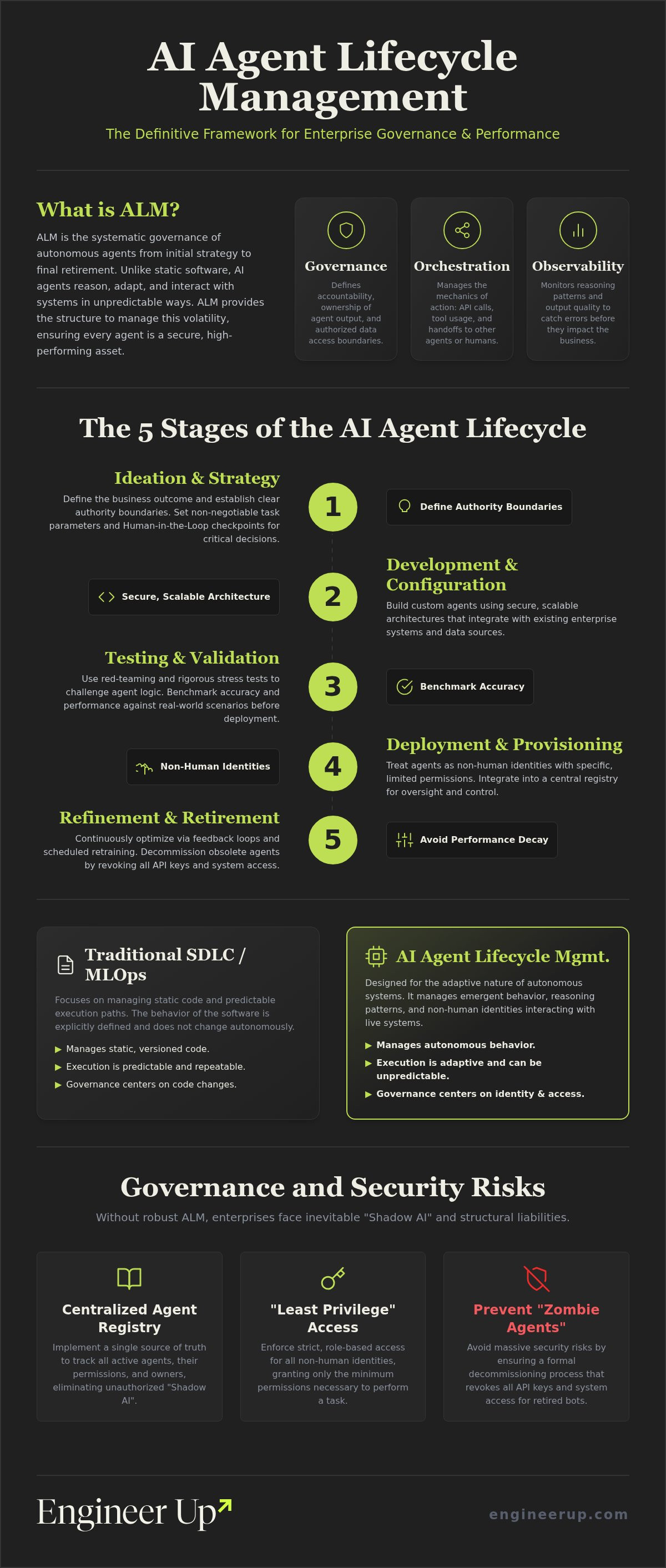
ALM is the systematic governance of autonomous agents from initial strategy to final retirement. Traditional software is static. Code executes as written. AI agents are different. They reason, adapt, and interact with external systems in ways that static code cannot predict. Implementing ai agent lifecycle management provides the structure needed to manage this volatility. It ensures every agent remains a secure, high-performing asset rather than a liability.
The core goal of this framework is to maintain alignment with business KPIs while mitigating operational risk. As enterprises move from legacy manual processes to intelligent agents, the margin for error disappears. You need a repeatable framework to oversee these digital workers. It isn't just about code. It's about behavior.
The Core Components of ALM
Managing an agent requires more than just monitoring uptime. It demands three structural pillars. When building custom ai chat agents for enterprise, these pillars ensure the architecture is sound from day one:
Governance
This defines accountability. You must establish who owns the agent's output and what specific data it is authorized to touch.
Orchestration
This handles the mechanics of action. It manages how agents call APIs, use internal tools, and hand off tasks to other agents or humans.
Observability
This goes beyond logs. You must monitor reasoning patterns and output quality to catch errors before they impact the bottom line.
Why Enterprise ALM is Non-Negotiable in 2026
The stakes for autonomous deployment have shifted. By 2026, the volume of non-human identities within a typical enterprise will likely exceed human staff. Without ai agent lifecycle management, "Shadow AI" becomes inevitable. This occurs when departments deploy unauthorized agents that access sensitive databases without oversight.
Beyond security, performance decay is a constant threat. Model drift and hallucinations can turn a productive agent into a source of misinformation. ALM provides the guardrails to detect these shifts early. It also ensures compliance with national AI regulations that now demand transparent audit trails for autonomous decisions. Legacy management styles won't work here. You need a framework built for the speed of AI.
The 5 Stages of the AI Agent Lifecycle
Effective ai agent lifecycle management follows a rigid, five-phase progression. Skipping a single step creates technical debt that compounds over time. This framework ensures that every deployment is intentional, secure, and aligned with your broader operational goals.
Phase 1 starts with Ideation and Strategy. You must define the business outcome before touching a single line of code. Phase 2 involves Development and Configuration. This is where you build custom ai chat agents for enterprise using secure, scalable architectures. Phase 3 focuses on Testing and Validation. We use red-teaming to stress-test logic and benchmark accuracy against real-world scenarios. Phase 4 is Deployment and Provisioning. This phase treats agents as non-human identities with specific, limited permissions. Phase 5 is Refinement and Retirement. You either optimize the agent through feedback or decommission it when it no longer serves a strategic purpose.
Ideation: Setting Authority Boundaries
Authority boundaries are non-negotiable. You must define specific task parameters to prevent agents from over-reaching into unauthorized systems. Establish human-in-the-loop (HITL) checkpoints for any decision involving financial transactions or sensitive legal data. Identify required data integrations and API permissions during this initial phase. This prevents security bottlenecks later in the cycle. Clear boundaries protect your infrastructure and your reputation.
Refinement: Avoiding Performance Decay
Performance decay is a quiet killer of enterprise ROI. Implement automated feedback loops from end-user interactions to catch hallucinations before they escalate. Schedule periodic retraining sessions. Use fresh enterprise data to keep the agent knowledge base current and relevant. An agent is considered obsolete when its error rate exceeds the cost of manual intervention. Continuous optimization is the only way to maintain long-term business value.
Decommissioning: Preventing Zombie Agents
Zombie agents are retired bots that still possess active system access. They represent a massive, overlooked security risk in the modern enterprise. To prevent this, revoke all API keys and system access the moment an agent is retired. Archive interaction logs to maintain strict compliance and audit trails. Finally, transition active workflows to successor agents or legacy systems to ensure business continuity. Managing the end of the life cycle is as critical as the beginning. If you are struggling to scale these processes, our Strategy Consulting experts can help you build a repeatable deployment model.
ALM vs. Traditional MLOps and SDLC
Traditional software development lifecycles (SDLC) prioritize code stability. MLOps focuses on model performance and data drift. Neither framework is equipped to handle the autonomy of an AI agent. While SDLC ensures the application runs and MLOps ensures the model predicts, ai agent lifecycle management ensures the agent behaves according to enterprise intent. This shift from managing code to managing behavior represents the next evolution in digital governance.
Agents are not just scripts. They are autonomous actors that make probabilistic decisions. This unpredictability bridges the gap between technical performance and strategic business value, but only if managed correctly. Without a dedicated ALM framework, you are essentially deploying a black box into your production environment. You need more than just uptime metrics. You need behavioral oversight.
The Identity Distinction
Standard software applications typically rely on service accounts. These accounts have fixed permissions. AI agents require a more sophisticated approach. They must be treated as "non-human identities" with specific roles and accountability structures. They aren't just tools; they are digital workers.
A significant risk in autonomous networks is privilege creep. This occurs when an agent accumulates permissions across multiple systems to complete a complex task but never relinquishes them. Unlike a service account that performs a single, repetitive function, an agentic identity might traverse CRM, ERP, and communication platforms. Without ai agent lifecycle management, these over-privileged identities become massive security vulnerabilities. You must implement a governance layer that monitors identity health as strictly as system uptime.
Continuous Reasoning vs. Fixed Logic
Traditional unit tests are designed for deterministic outputs. You provide input A, and you expect output B. Agents operate in a probabilistic environment. They use continuous reasoning to navigate tasks. This means they can drift in their "judgment" even if the underlying code remains unchanged. Logic that worked on day one might fail on day thirty as the agent encounters new data patterns.
We call this reasoning drift. It is a subtle decay where an agent's logic becomes less efficient or begins to ignore established guardrails. Traditional monitoring tools miss this. You need specialized observability to track reasoning patterns over time. Managing this complexity requires a shift in how you view deployment. Many firms utilize enterprise ai agent consulting to build these advanced monitoring architectures. By 2026, the ability to validate reasoning will be more important than the ability to validate code. It's the difference between a tool that works and a worker you can trust.
Governance and Security in the Agent Lifecycle
Security is the foundation of any enterprise deployment. Without it, autonomy becomes a liability. A robust ai agent lifecycle management strategy requires a centralized registry for every active agent in your ecosystem. This registry acts as the single source of truth. It tracks ownership, purpose, and the specific systems each agent can access. If an agent isn't in the registry, it shouldn't have access to your network. This visibility is the first step in preventing "Shadow AI" from compromising your data integrity. To proactively defend these environments, organizations often leverage offensive security expertise from AppSecure Security to identify and mitigate potential attack vectors.
Governance must be granular. You must implement "Least Privilege" access for every autonomous agent. Don't give an agent broad database access if it only needs to read three specific tables. Every tool call and data access event must generate an audit trail. These trails allow you to map agent actions directly to industry-specific regulations. Compliance isn't a checkbox; it's a continuous technical requirement. You need the ability to prove exactly why an agent took a specific action at any given time.
Every deployed agent needs a unique identifier. Treating agents as generic service accounts is a mistake. Unique identifiers allow you to track behavior across distributed systems. You must also manage the lifecycle of credentials. Rotating API secrets and managing keys is as critical for agents as it is for human staff. NHI governance prevents unauthorized data exfiltration by ensuring every agent action is bound to a verified identity with strictly scoped permissions. This level of control is essential for maintaining a secure perimeter in a multi-agent environment.
Auditability and Traceability
Transparency is required for trust. You must create immutable logs for every decision-making process an agent undergoes. These logs are more than just debug files. They are forensic tools. When an agent enters a "hallucination loop," these logs allow you to pinpoint the exact reasoning failure. You can see the input, the retrieved data, and the probabilistic choice that led to the error. This data is vital for troubleshooting and refinement.
Preparing for external audits is the final piece of the governance puzzle. As national AI regulations tighten, your business processes will face scrutiny. You must be able to produce a clear, chronological record of agent behavior. This proves that your autonomous workers operate within legal and ethical boundaries. Building these logs into the lifecycle from day one saves hundreds of hours of manual reporting later. If you need to secure your autonomous workflows, our team provides the Ongoing Support required to maintain elite security standards.
Strategic Implementation: Scaling with Professional Support
Scaling an autonomous workforce isn't a one-time event. It's a continuous engineering challenge. Most organizations stall at the pilot phase because they lack a repeatable framework for ai agent lifecycle management. Moving from experimental demos to high-performance enterprise deployments requires a shift in focus from "can it work" to "how does it scale." This transition demands deep integration with your existing infrastructure and a commitment to ongoing technical oversight. You can't treat production agents like experimental toys.
Bespoke development is the only path to meaningful ROI for specialized business tasks. Off-the-shelf models often lack the context required to navigate complex internal workflows. By focusing on custom ai app development for business, you ensure that every agent is purpose-built for your specific industry requirements. This tailored approach allows you to bake governance and performance metrics directly into the agent's DNA from day one. Customization isn't a luxury. It's a requirement for accuracy.
The Role of Specialized Integration
Modernizing legacy workflows doesn't mean replacing every system you own. It means building intelligent layers that connect them. We utilize power apps consulting services to bridge the gap between legacy data and modern autonomous agents. This integration ensures that your agents have the access they need without compromising system stability. Scaling effectively means ensuring your agents can talk to your ERP, CRM, and internal databases with zero friction. It turns siloed data into an actionable resource.
The Engineer Up Approach to ALM
Ongoing support is the cornerstone of our approach. Agents aren't static assets. They require constant tuning to maintain uptime and accuracy as your business data evolves. Our strategic consulting identifies the highest-impact automation opportunities first. We don't automate for the sake of technology; we automate for the sake of efficiency. We ensure your digital workforce grows alongside your human staff—if you are looking to scale your human support team, you can visit Amplify Yourself, LLC—maintaining elite performance standards through every phase of the lifecycle. This is how you transform a technical experiment into a long-term competitive advantage.
The era of experimental AI is over. By 2026, the distinction between market leaders and laggards will rest on their mastery of ai agent lifecycle management. Success requires moving beyond simple automation to a structured governance model that treats agents as high-performance digital identities. You must prioritize behavioral oversight, rigorous identity management, and continuous refinement to prevent technical debt and security vulnerabilities. Managing these systems is no longer a side project; it's a core operational requirement.
Managing this complexity alone is a structural risk. Engineer Up provides the specialized force needed for direct, outcome-focused implementation and ongoing technical support for enterprise-grade agents. As a boutique consulting firm specializing in high-performance AI, we assume the technical burden so your leadership can focus on primary business objectives. The transition from legacy processes to intelligent agents is inevitable. We ensure it's also profitable and secure. Build a digital workforce that stands on a foundation of precision and elite reliability.
Optimize your enterprise AI agent lifecycle with Engineer Up and secure your organization's future in the autonomous economy.
Frequently Asked Questions
What is the difference between ALM and MLOps?
MLOps focuses on model performance and data drift. ALM extends this by governing how an autonomous agent interacts with external systems and makes decisions. In ai agent lifecycle management, you aren't just monitoring a model's prediction accuracy. You are overseeing a non-human identity's actions across your enterprise. This includes managing permissions, tool usage, and reasoning patterns that fall outside the scope of traditional machine learning operations.
How do you prevent an AI agent from accessing sensitive data?
You prevent unauthorized access by enforcing strict "Least Privilege" protocols for every agent identity. Every agent must have its own unique identifier with scoped permissions limited to the specific tables or files required for its task. Use centralized registries to monitor these permissions in real time. This ensures that an agent designed for customer support cannot pivot into financial records, effectively neutralizing the risk of unauthorized data exfiltration.
When should an enterprise retire an AI agent?
Retirement is necessary when an agent's maintenance cost or error rate outpaces its strategic value. If an agent suffers from persistent reasoning drift that retraining cannot fix, it is a liability. You should also decommission agents when the legacy systems they interact with are replaced. A clear retirement trigger is part of effective ai agent lifecycle management, preventing the accumulation of "zombie agents" that drain resources and create security gaps.
Can ALM be automated using Power Platform tools?
Power Platform tools are ideal for automating the administrative layers of the agent lifecycle. You can use Power Automate to trigger permission reviews or revoke API keys when an agent is flagged for retirement. Power BI provides the observability needed to track performance metrics and ROI. Integrating these tools into your framework allows for a scalable, low-code approach to managing a growing fleet of autonomous enterprise agents across your infrastructure.
What are the main security risks in the AI agent lifecycle?
The primary risks include over-privileged non-human identities and unauthorized data access. Privilege creep occurs when agents retain access rights they no longer need for their current tasks. Without immutable logs, you cannot trace a hallucination back to its source. This lack of traceability makes it impossible to defend against external audits or identify where a reasoning loop failed. Secure lifecycles demand constant identity rotation and granular, role-based access controls.
How do you measure the ROI of an AI agent throughout its life?
Measure ROI by comparing the cost of agent development and ongoing support against the value of reclaimed human hours. Track specific KPIs such as task completion velocity and the reduction of manual entry errors. You must also factor in the cost of technical debt avoided through proactive management. High-performance agents should deliver a clear multiplier on operational efficiency, moving beyond mere cost savings to long-term strategic value generation.
Does every AI agent need a human-in-the-loop?
Human-in-the-loop is mandatory for any decision involving financial transactions, legal compliance, or customer safety. While low-risk tasks can be fully autonomous, high-stakes workflows require human validation at critical checkpoints. This ensures that the agent's probabilistic reasoning remains aligned with enterprise standards. By 2026, the standard for elite supervision is a tiered approach where human intervention is reserved for exceptions and high-value strategic approvals to maintain operational integrity.
How often should an AI agent be retrained?
Retraining isn't based on a calendar; it's based on performance. You must retrain an agent whenever its accuracy falls below established benchmarks or when your enterprise data undergoes structural changes. Continuous monitoring detects these shifts early. In a fast-moving business environment, this might mean monthly updates or real-time feedback loops. Proactive retraining prevents model drift and ensures the agent remains an accurate reflection of your current operational reality and business logic.
WRITTEN BY
Get Your Team AI Ready
Let's hear your use case - we'll help you get on the path to AI readiness.

FILED UNDER
TOOLS IN THIS POST